_edited_edited.jpg)

Fractional Controller Services: The Strategic Framework for Scaling Your Firm in 2026

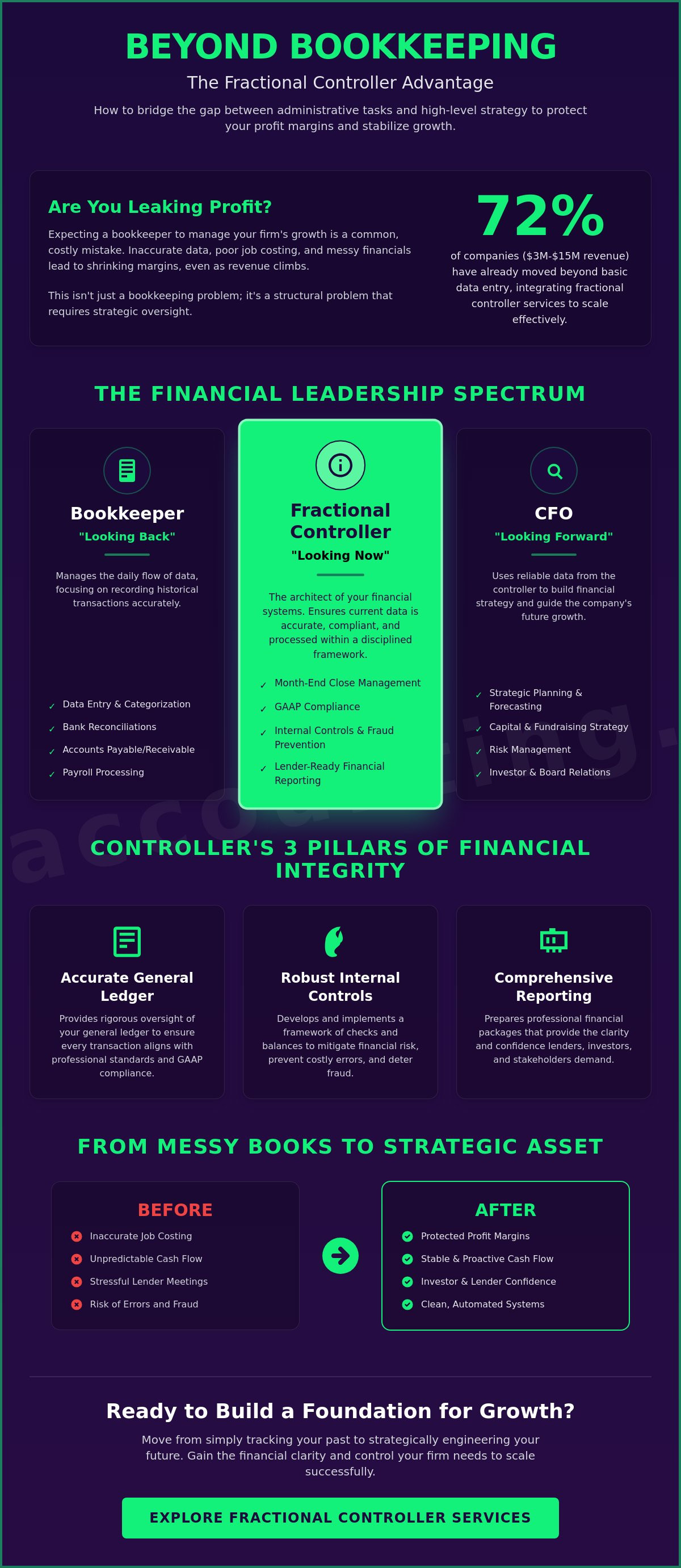
Your bookkeeper is not a financial strategist, and expecting them to manage your firm's growth is likely costing you thousands in leaked profit every month. Recent market data shows that 72% of companies with revenues between $3 million and $15 million have already moved beyond basic data entry to integrate fractional controller services into their scaling strategy. You likely feel the weight of this transition when inaccurate job costing shrinks your margins or when lender meetings feel like an interrogation because your financials are messy. It's frustrating to watch your revenue climb while your actual profit feels more fragile than ever.
This article will show you how to bridge the gap between administrative tasks and high-level strategy to protect your profit margins and stabilize growth. We'll explore the framework for building lender-ready financial statements and implementing the internal controls necessary to prevent errors or fraud. By the end, you'll understand how to transform your QuickBooks into a clean, automated system that drives proactive cash flow management. It's time to move from simply tracking your past to strategically engineering your future.
Key Takeaways
Understand the critical transition from basic data entry to professional oversight provided by fractional controller services to ensure your financial data is both accurate and actionable.
Learn how specialized financial oversight protects project-based profit margins by identifying hidden costs and stabilizing cash flow before they impact your bottom line.
Gain a clear framework for distinguishing between controller and CFO roles to determine which level of strategic leadership your firm requires for its current growth stage.
Discover the step-by-step process for transforming messy financial records into a clean, automated QuickBooks Online system that supports long-term structural integrity.
Identify the essential internal controls needed to mitigate the risk of fraud and errors while preparing your firm for successful lender or investor meetings.
What Are Fractional Controller Services?
Scaling a firm requires a fundamental shift from simple record-keeping to sophisticated financial oversight. Fractional controller services provide this high-level leadership on a part-time, remote basis, allowing firms to access specialized expertise without the overhead of a full-time executive. This model is designed for modern businesses that need structural integrity in their accounting departments but aren't yet ready for a permanent department head. It moves your firm beyond basic administrative tasks and into the realm of strategic financial management.
The focus of a fractional controller is rooted in accuracy, GAAP compliance, and the implementation of rigorous internal controls. While a bookkeeper manages the daily flow of data, the controller ensures that data is processed within a framework of professional discipline. This nationwide remote service model allows you to partner with experts who understand the unique mechanics of your industry, regardless of your physical location. It's about building a proactive defense for your profit margins through precise reporting and disciplined oversight. You can explore how these fractional controller services stabilize your operations by visiting our service overview.
The Bridge Between Bookkeeping and CFO Strategy
Think of the controller as the architect of your financial systems. While bookkeeping is primarily concerned with "looking back" to record historical data, controllership focuses on "looking now" to ensure current systems are functional and accurate. They manage the month-end close process with surgical precision. This ensures that every balance sheet account is reconciled and every project cost is correctly allocated. By acting as the bridge to CFO strategy, they transform raw data into the reliable insights required for high-level decision making. Without this middle layer, even the best CFO cannot build a stable future for the firm.
Core Responsibilities of a Fractional Controller in 2026
In the current business environment, the role of a Comptroller or controller has evolved to prioritize three specific pillars. First, they provide oversight of general ledger maintenance to ensure every transaction aligns with professional standards. Second, they develop robust internal controls to mitigate financial risk and prevent fraud. Finally, they prepare comprehensive financial packages for stakeholders. These reports provide the clarity lenders and investors demand, ensuring your firm is always ready for its next growth milestone or audit. This methodical approach ensures that your financial data is a tool for growth rather than a source of anxiety.
The Strategic Value of Fractional Oversight for Contractors and Investors
For contractors and real estate investors, the stakes of financial mismanagement are exceptionally high. You don't just need someone to file a tax return at the end of the year. You need a structural framework that protects your cash flow every single day. Relying solely on a tax preparer leaves a massive gap in your operational visibility because they focus on the past rather than the present. Fractional controller services fill this void by providing the specialized oversight necessary to manage complex project cycles. This fractional approach for startups and scaling firms allows you to build a foundation of credibility with outside partners. When you sit down with a lender or bonding agent, you aren't presenting "messy" books. You're presenting a proactive defense of your profit.
The personality of a disciplined mentor is vital in this environment. You need a partner who doesn't just hand you a report but explains the broader implications of your financial health. Our team acts as this strategic partner, focusing on the structural integrity of your firm. We move you from a state of reactive stress to one of operational clarity. Professional oversight ensures that your financial data is a reliable asset rather than a source of anxiety during investor meetings.
Job Costing and WIP: The Controller’s Secret Weapons
Work-in-Progress (WIP) accounting is the essential mechanism that aligns revenue with the actual stage of completion on a construction project to ensure true profitability. A controller ensures every project cost, from labor to materials, is tracked in real-time rather than at the end of the month. This discipline prevents the "cash flow surprise" that occurs when a project appears profitable on paper but is actually bleeding cash. Protecting your profit margins isn't about cutting costs; it's about having the data to see where those costs are actually going. By conducting regular over/under billing analysis, your controller identifies whether you're financing the client's project or if they're financing your growth. This level of granular detail is what separates a struggling contractor from a scaleable firm.
Real Estate Investor Financial Frameworks
Managing a multi-entity property portfolio requires more than basic bookkeeping. It demands a rigorous framework for tracking capital accounts and ensuring investor distributions are calculated with precision. If you find yourself buried in spreadsheets trying to reconcile intercompany transfers, you're losing time that should be spent on acquisitions. Our approach to accounting for real estate investors focuses on building these foundational systems. A controller manages the complexities of depreciation, debt service coverage ratios, and equity tracking across multiple LLCs. This ensures your data is always ready for your next capital raise or lender review. If you're ready to move beyond the chaos of manual tracking, you might consider scheduling a strategy session to review your current systems. Utilizing fractional controller services allows you to scale your portfolio with the confidence that your financial structure is built to last.
Controller vs. CFO for Small Business: Navigating the 2026 Landscape
Many business owners mistake a controller for a senior bookkeeper; this is a costly error that often leads to operational stagnation. A high-functioning finance department operates on a clear hierarchy of data integrity. At the base, you have monthly bookkeeping for data entry. At the top, you have the CFO for high-level capital strategy and fundraising. The controller occupies the critical middle ground. They are the architects of your financial systems and the guardians of the general ledger. Without a controller, a CFO is just guessing based on potentially flawed data. For a deeper dive into these distinct roles, see our guide on controller vs cfo for small business.
When the Controller Is the Right Choice
The "Complexity Trigger" usually occurs when your firm hits a high volume of transactions across multiple projects or entities. If you have the data but lack the system to verify its accuracy, you don't necessarily need a CFO yet. You need the structural framework that fractional controller services provide. Clean data is the prerequisite for any meaningful forecasting. A controller ensures that your month-end close is airtight; they verify that every job cost is allocated and every liability is accounted for. They provide the "looking now" perspective that stabilizes your current operations. This discipline creates the reliable foundation required before you can even begin to think about long-term financial modeling.
Calculating the ROI of Specialized Oversight
The financial math for specialized oversight is compelling when compared to the cost of a full-time executive. A full-time CFO's total compensation often ranges between $180,000 and $280,000 for companies in the $5M to $15M revenue bracket. The average U.S. salary for a full-time CFO is approximately $230,000. In contrast, a fractional engagement typically costs 40% to 60% less than the total compensation for an equivalent full-time hire.
The most significant ROI comes from avoiding the "Cost of Inaction." This includes missed billings, payroll errors, and the "tax surprises" that occur when your books aren't GAAP-compliant. You can review our detailed breakdown of fractional controller pricing to plan your budget effectively. By investing in oversight now, you prevent the expensive cleanup projects that plague firms with messy financials. It's a proactive choice that pays for itself through improved decision making and profit protection.
How to Implement Fractional Controller Services in Your Business
Transitioning from administrative bookkeeping to a structured framework requires a methodical approach. Implementing fractional controller services isn't a simple hand-off of tasks. It's the installation of a strategic oversight system designed to protect your firm's long-term health. We begin by identifying the structural weaknesses in your current data flow and replacing them with rigorous, automated processes. This transformation ensures that your QuickBooks Online system becomes the single source of truth for every project and entity you manage.
Step 1: The Financial Health Assessment
We start with a deep dive into your existing records to identify gaps in internal controls and bookkeeping accuracy. This assessment includes a thorough review of your chart of accounts to ensure it aligns with industry-specific standards for construction or real estate. We establish a baseline for project profitability, identifying which jobs are contributing to your margin and which are leaking cash. Without this diagnostic phase, any attempts at scaling will only amplify existing inefficiencies. We focus on stabilizing the foundation before we build the expansion.
Step 2: System Optimization and QuickBooks Integration
Modern firms require real-time visibility that only cloud-based systems can provide. A professional QuickBooks setup is the central hub of this strategy. Your controller automates the data flow between your field operations and your accounting software to reduce the risk of human error. This optimization ensures that your financial data is captured as it happens, not weeks after the fact. We shift your team away from manual spreadsheets and toward a centralized, secure environment that supports scalable growth.
Step 3: Establishing the Monthly Financial Cadence
Consistency is the hallmark of a disciplined finance department. We implement a strict month-end close process to ensure every account is reconciled and every project cost is verified. This cadence culminates in the delivery of a comprehensive financial package and a strategic review meeting. During these sessions, we move beyond the numbers to discuss their operational implications. This shift allows you to make data-driven decisions based on facts rather than intuition. You'll gain a "Lender-Ready" checklist that includes:
Fully reconciled balance sheets for all entities
Accurate Work-in-Progress (WIP) reports
Detailed cash flow forecasts for the next 90 days
Verified intercompany transfer logs
If you're ready to stop guessing about your profitability and start managing with precision, you can book a discovery call to begin your implementation process. Our goal is to provide the clarity you need to lead with confidence.
Transforming Your Financial Data with Okie Accounting Group LLC
Okie Accounting Group LLC doesn't just manage books; we build the structural frameworks that allow your firm to scale without losing its foundation. Our role is that of a strategic mentor, guiding you through the transition from granular operational details to the broader implications of your financial health. We understand that for construction firms and real estate investors, data is only as valuable as the profit it protects. By choosing our fractional controller services, you gain a partner who is as invested in your long-term stability as you are. We speak the language of your industry, from project-based tracking to complex entity management. Our goal is to replace your financial anxiety with the quiet confidence that comes from total data control.
Specialized Expertise in Construction and Real Estate
Our firm focuses exclusively on the niche-specific complexities that generalist providers often overlook. We recognize that your business isn't just a series of transactions; it's a portfolio of projects and properties that require meticulous oversight. Our management accounting approach is inherently proactive. We don't wait for the end of the year to tell you where you lost money. Instead, we provide the clarity needed to adjust your course in real-time, protecting your margins before they shrink. If you feel that your current systems are failing to provide the insight you need, we invite you to a strategy session to evaluate your existing framework and identify immediate opportunities for improvement. This disciplined approach ensures that your firm remains stable, even during periods of rapid expansion.
Your Strategic Partner for Nationwide Growth
The modern business landscape has removed the traditional barriers to high-level financial leadership. You can access specialized expertise remotely, ensuring that your firm has the same structural integrity as a much larger organization. This nationwide accessibility means that distance is no longer a factor in your ability to secure a disciplined and forward-thinking financial partner. We move you from a state of complexity to one of operational clarity, allowing you to focus on high-level growth while we maintain the integrity of your systems. It's about moving beyond administrative tasks to embrace a future of data-driven choices.
To understand the full scope of this role and how it differs from other financial positions, we encourage you to read more about what does a fractional controller do in our detailed guide. When you're ready to move beyond basic administration and into strategic growth, you can schedule a consultation for Fractional Controller Services. Let's build the financial foundation your firm deserves for 2026 and beyond.
Build Your Structural Framework for Growth
Scaling a firm in 2026 requires more than just high revenue; it demands a disciplined financial framework that protects every dollar earned. You've seen how bridging the gap between basic bookkeeping and strategic leadership ensures your data is both accurate and actionable. By implementing fractional controller services, you move beyond reactive accounting and begin making data-driven decisions that stabilize your long-term growth. This professional oversight provides the internal controls and precise reporting necessary to satisfy lenders and investors alike.
Our team specializes in construction and real estate, providing the nationwide remote support you need to maintain structural integrity. We focus on expert QuickBooks Online integration to automate your systems and reduce the risk of human error. It's time to stop feeling anxious about "messy" financials and start leading with clarity. We're ready to act as your strategic partner in this transformation.
Gain Financial Clarity with Fractional Controller Services
Your firm's future depends on the systems you build today. We look forward to helping you construct a foundation that lasts.
Frequently Asked Questions
What is the difference between a bookkeeper and a fractional controller?
A bookkeeper is responsible for the daily entry of financial transactions; a fractional controller provides the professional oversight and system architecture to ensure that data is accurate. While the bookkeeper records history, the controller ensures that your firm follows GAAP and maintains rigorous internal controls. This distinction is the difference between simple record-keeping and strategic financial management that protects your profit margins.
How much do fractional controller services cost for a construction company?
Fees for fractional controller services are typically structured as a monthly retainer based on the complexity of your project data and transaction volume. While we don't quote specific prices here, firms with $2M to $10M in revenue generally find this model costs 40% to 60% less than a full-time executive salary. This investment pays for itself by identifying cost leaks and stabilizing your cash flow.
Can a fractional controller help my business get a bank loan or bonding?
Yes, a fractional controller prepares the lender-ready financial statements and WIP reports that banks and bonding agents demand for approval. They ensure your balance sheet is reconciled and your reporting is transparent. This professional oversight increases your credibility with stakeholders. It demonstrates that your firm has the structural integrity and financial discipline required to manage larger projects or increased debt.
How many hours a month does a fractional controller typically work?
Most fractional engagements range from 10 to 20 hours per month depending on your firm's specific needs and growth stage. Some companies require intensive support during a software transition or scaling phase. Others need steady monthly oversight of the month-end close process. This flexible model allows you to scale the level of professional leadership as your transaction volume and complexity increase.
Will a fractional controller replace my current CPA or tax preparer?
No, a fractional controller works alongside your tax preparer by providing them with clean, reconciled data at year-end. We don't offer income tax preparation or certified audits. Instead, we act as the internal financial lead who ensures your records are accurate throughout the year. This partnership makes the tax season much smoother and reduces the expensive cleanup fees often charged by tax CPAs.
How does a fractional controller improve my job costing in QuickBooks?
A fractional controller improves job costing by implementing a rigorous framework for tracking labor, materials, and overhead against specific projects. They ensure that every expense is allocated correctly in QuickBooks Online. This discipline allows you to see true project profitability and perform over/under billing analysis with precision. You'll move from guessing about your margins to managing them with factual, real-time data.
Is my business too small for fractional controller services?
Your business is ready for fractional controller services when your transaction volume exceeds your ability to verify data accuracy. If you feel that messy financials are hindering your growth or causing anxiety during lender meetings, you aren't too small. The fractional model is specifically designed for firms that need high-level expertise and profit protection without the overhead of a full-time executive salary.
What industries do you specialize in for controllership?
We specialize in construction companies and real estate investors. These sectors face unique challenges related to project-based tracking, multi-entity portfolios, and complex capital distributions. By focusing on these specific niches, we provide industry-specific insights that a generalist provider cannot offer. We ensure your financial systems are built to handle the unique mechanics of your specific market and project cycles.



Comments