_edited_edited.jpg)

What Does a Fractional Controller Do? A Strategic Guide for 2026

What if your shrinking project margins aren't caused by rising material costs, but by a structural failure in your financial oversight? You've likely felt the weight of scaling your construction or real estate firm, only to find that your financial data lags behind your growth. It's frustrating to reach the end of a job and realize the profit you expected isn't actually in the bank. You know you need more than basic administrative support, yet a full-time executive salary doesn't make sense for your current stage. Understanding exactly what does a fractional controller do is the first step toward reclaiming control of your project costing and long-term stability.
You deserve a financial partner who treats your business with the same discipline you bring to a job site. This guide will show you how a fractional controller provides the high-level oversight and structural integrity needed to scale without the chaos. We'll preview the specific ways they improve cash flow predictability and build a scalable framework that keeps you lender-ready for 2026. By the end of this article, you'll see how to transition from reactive bookkeeping to proactive, strategic financial management that protects your bottom line.
Key Takeaways
Learn how a fractional controller serves as the tactical leader of your financial department to protect project margins and data integrity.
Understand exactly what does a fractional controller do to manage the monthly close process and optimize your firm’s working capital.
Identify the specific red flags, like stagnant cash flow during revenue growth, that indicate your business is ready for high-level oversight.
Discover the hierarchy of financial roles to determine whether your firm needs a historical bookkeeper or a system-focused controller.
Explore the benefits of cloud-based structural frameworks that provide real-time data and keep your real estate or construction firm lender-ready.
Defining the Fractional Controller Role for Growth-Minded Firms
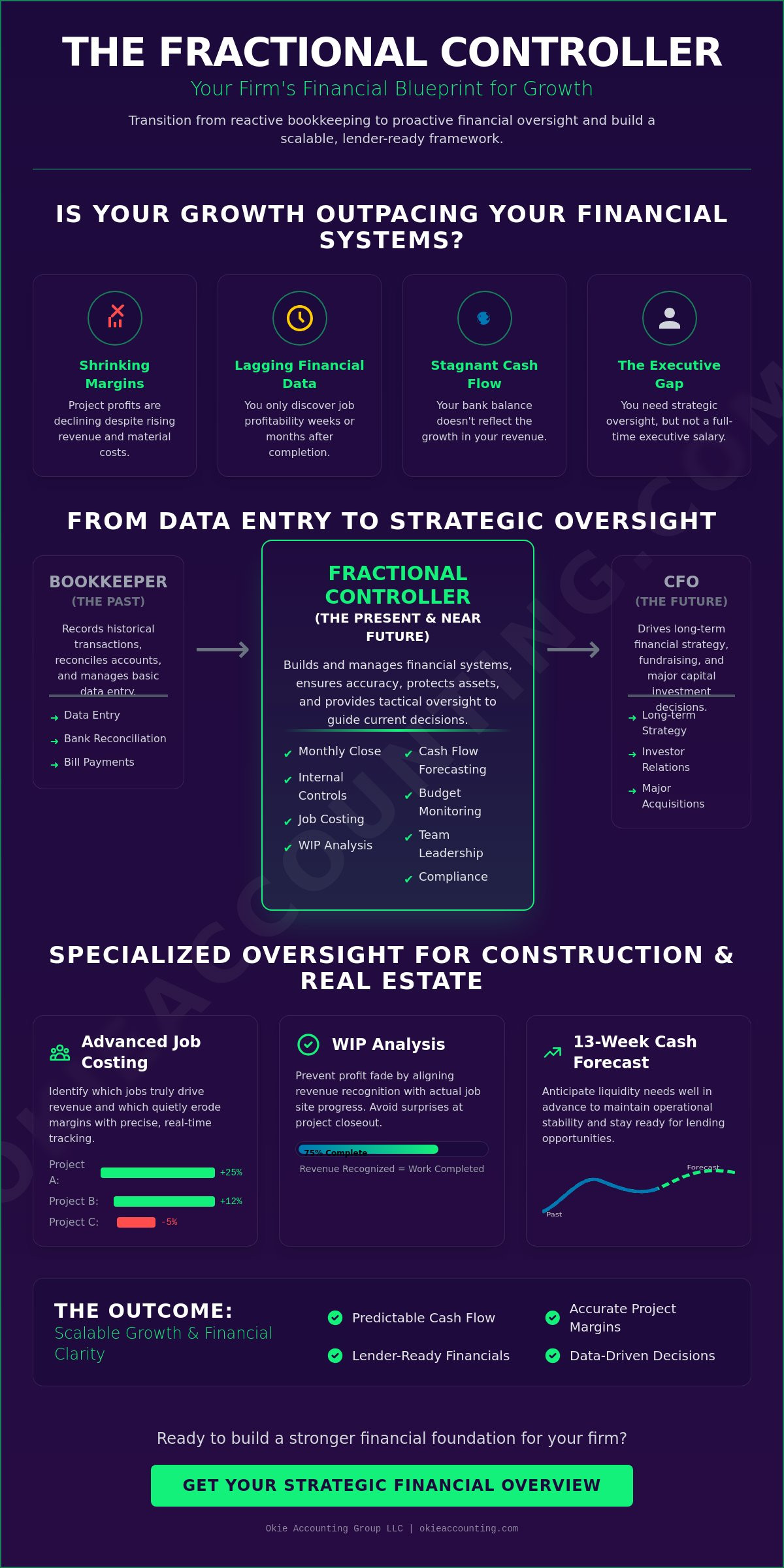
Growing construction and real estate firms often find themselves in a precarious middle ground. Your volume of work is increasing, but your financial systems are still built for a smaller operation. This gap creates significant risk. A fractional controller provides high-level financial oversight on a part-time or project basis, stepping in to bridge that gap. They act as the tactical leader of your financial department, ensuring data integrity and providing the discipline needed to maintain accurate project costing. When owners ask, what does a fractional controller do, they are often looking for someone to take the burden of financial accuracy off their shoulders. While a bookkeeper is essential for recording transactions, the controller focuses on the "why" and "what next" of your financial data. Essentially, a fractional controller serves as a strategic mentor who builds the foundational systems required for long-term financial health and operational clarity.
The Strategic Bridge: Between Bookkeeping and CFO Leadership
Bookkeeping records the past; the controller manages the present and protects the future. Within the framework of a fractional executive arrangement, your firm gains access to specialized talent that would otherwise be cost-prohibitive. They translate granular transactions into high-level business intelligence, allowing you to make decisions based on facts rather than intuition. This model is particularly effective for firms that need executive-level oversight without the full-time salary commitment. It provides a steady rhythm of reporting and analysis that keeps the business moving forward. By answering the question of what does a fractional controller do through a lens of leadership, you can see how they coordinate your accounting staff to produce reliable, timely results.
Core Objectives: Accuracy, Compliance, and Structural Integrity
Accuracy and compliance are the bedrock of any successful real estate or construction enterprise. Our fractional controller services focus on ensuring all financial reporting follows GAAP or industry-specific accrual methods. This is critical for accurate job costing and revenue recognition on long-term projects. Beyond reporting, they establish internal controls to prevent fraud and reduce the types of operational errors that eat away at margins. By maintaining lender-ready financials, they ensure that when you need to secure bonding or a new credit line, your books are already in order. This proactive stance moves your accounting from a back-office necessity to a strategic asset that supports your firm's long-term health.
Core Responsibilities: Beyond Basic Bookkeeping to Financial Oversight
When you evaluate what does a fractional controller do, you'll find they serve as the tactical engine of your financial department. They don't just record transactions. They ensure that every dollar moving through your business is accounted for and utilized efficiently. This role encompasses a wide range of Financial Controller Responsibilities, but for a growing firm, the focus is on maintaining structural integrity. By overseeing the monthly close process, they provide you with accurate financial statements while there's still time to act on the data. They also manage accounts receivable and payable to optimize your firm’s working capital, ensuring that your operations aren't strangled by poor collections or aggressive vendor terms.
A disciplined controller also acts as a mentor and leader for your existing staff. Whether you have an in-house team or use outsourced support, the controller establishes the standards for performance. Their oversight includes:
Internal Controls: Implementing and enforcing protocols to safeguard business assets and prevent fraud.
Budget Monitoring: Developing annual budgets and comparing them to monthly actuals to catch variances early.
Team Leadership: Guiding your accounting staff to ensure data entry remains consistent and accurate.
Operational Efficiency: Streamlining the flow of financial information from the field to the office.
Advanced Reporting: Job Costing and WIP Analysis
High-level oversight requires a solid foundation built on specialized construction bookkeeping services. Without accurate project-level tracking, true profitability remains a mystery. A fractional controller implements Work in Progress (WIP) analysis to prevent the common pitfalls of over-billing or under-billing. This ensures that your revenue recognition aligns with the actual progress on the job site, protecting you from sudden profit fades at the end of a project. They track project-level profitability to identify which jobs are truly driving revenue and which are quietly eroding your margins.
Cash Flow Management and Forecasting
Liquidity is the lifeblood of real estate and construction. A controller develops 13-week cash flow forecasts to predict needs well before a liquidity crunch occurs. This foresight allows you to manage vendor relationships and payment timing with confidence. By aligning project spending with actual cash availability, you avoid the over-extension that often accompanies rapid growth. If you are ready to move from guessing to knowing, you might consider discussing your specific financial framework with a dedicated partner who understands the mechanics of your industry.
Controller vs. Accountant vs. CFO: Understanding the Hierarchy
Many business owners use the terms "accountant" and "controller" interchangeably, yet the difference in impact is profound. To understand what does a fractional controller do, you must first view the financial department as a hierarchy of specialized functions. At the base, the bookkeeper or staff accountant focuses on historical accuracy, recording transactions and reconciling accounts. They tell you where your money went. At the top, a CFO manages high-level capital structure and long-term strategy. The controller sits firmly in the middle. They focus on the systems, oversight, and internal compliance that ensure your data is actually reliable. While a CFO looks toward the horizon to navigate the ship's course, the controller ensures the engine room is running at peak efficiency.
The Controller: Focuses on systems, oversight, reporting accuracy, and internal compliance.
The CFO: Focuses on high-level capital structure, long-term strategy, and external relationships.
Why the Controller is the Tactical Engine of Your Business
Without this middle layer of oversight, bookkeeping data often remains "noisy" and unactionable for the owner. You might have a list of transactions, but you lack the structural integrity to know if your project costing is truly accurate. The controller provides the essential "check and balance" needed to verify that the underlying bookkeeping is correct. This includes ensuring that specialized systems, such as construction payroll services, are fully compliant and integrated into the broader financial framework. They transform raw data into business intelligence, protecting your profit margins from administrative oversights and ensuring every project is tracked with precision.
Choosing the Right Level of Support for Your Stage
Choosing the right level of support depends entirely on your firm's current stage of growth. Small firms typically only need clean, reconciled books to maintain basic operations. However, as you scale toward the $3 million to $10 million revenue mark, the need for structural control becomes urgent. Recent data indicates that 68% of companies in this revenue range are already utilizing or actively considering fractional oversight. For many contractors, the fractional controller is the "sweet spot" for mid-market scaling. It provides the discipline of a large-firm financial department without the prohibitive cost of a full-time executive hire. When determining what does a fractional controller do for your specific firm, consider your goals for the next 24 months. If those goals include scaling or seeking new credit lines, the controller’s focus on systems and reporting accuracy is your most valuable asset.
Recognizing the Signs: When Does Your Business Need Fractional Oversight?
Identifying the specific moment your business outgrows its current accounting structure is vital for profit protection. Many owners experience a frustrating paradox: revenue is climbing, yet the cash balance in the bank remains stagnant. This often signals that your project costing is inaccurate or your overhead is scaling faster than your margins. Understanding what does a fractional controller do helps you see how these symptoms are actually systemic failures that require high-level correction rather than just more data entry. When your financial data is no longer a tool for growth but a source of stress, it's time to re-evaluate your oversight.
Disorganized records become a liability when you need to act quickly. If you're applying for a bank loan or a new bonding limit and realize your financials aren't lender-ready, the delay can cost you a major contract. Common red flags include:
Monthly financial statements that arrive consistently late or contain frequent errors.
An inability to determine true profit margins on a per-project basis.
Feeling out of control as the business scales into new territories or larger jobs.
Relying on intuition because your balance sheet doesn't reflect your operational reality.
The Complexity Threshold: Scaling Beyond Simple Bookkeeping
Scaling a firm requires moving from gut feel to data-driven decision-making. There is a specific complexity threshold where simple bookkeeping is no longer sufficient to protect your interests. This often occurs when you face high-volume transactions, multi-state operations, or intricate payroll requirements. Recognizing when to hire a fractional controller becomes a necessity for survival in a competitive market. The 114% increase in hiring interim finance controllers since 2022 reflects a broader industry shift toward specialized oversight. At this stage, you need a partner who can build the frameworks that support rapid expansion without sacrificing accuracy.
Preparing for External Scrutiny: Lenders and Investors
Lenders and bonding agents require clean books and specific debt-to-equity ratios for approval. They look for transparency that basic administrative records rarely provide. A controller ensures your accounting for real estate investors or lenders is professional and disciplined. They act as your primary point of contact for external auditors, shielding you from the granular stresses of financial scrutiny. They translate your operational success into the technical language that financial institutions trust. If these symptoms sound familiar, you can schedule a discovery call to discuss how to bring structural integrity back to your firm.
Implementing Strategic Control: The Okie Accounting Approach
Okie Accounting Group provides a specialized approach that recognizes the unique mechanics of the construction and real estate markets. We aren't generalists. We are dedicated partners who understand that your financial health depends on project-level precision. When defining what does a fractional controller do within our framework, we focus on proactive, disciplined mentorship. Our services move you away from reactive fire-fighting and toward a state of operational clarity. If you've wondered what does a fractional controller do to stabilize a growing firm, the answer lies in our commitment to profit protection. We prioritize rigorous job costing and meticulous cash flow management, ensuring that your firm’s structural integrity remains unshakeable as you scale.
Customized Systems for Construction and Real Estate
Building a scalable firm requires more than just recording transactions. It requires a robust technological foundation. We implement cloud-based systems like QuickBooks for contractors to ensure you have access to real-time data from any job site. Our team doesn't just set up the software; we provide specialized software training to empower your internal staff. This ensures your QuickBooks setup is optimized for the specific reporting needs of your niche, from tracking retainage to managing complex vendor payments. We build the structural framework that allows your business to grow without the typical administrative bottlenecks that stall mid-market firms.
Your Partner in Financial Readiness
Financial readiness is the difference between a firm that survives and one that leads. By utilizing our controller services, you gain the confidence to make significant moves backed by data-driven clarity. You transition from being a service provider to a strategic leader in your market. This shift is essential in a landscape where 78% of companies with revenues between $10 million and $25 million already utilize these high-level services to maintain their edge. We provide the stability needed to navigate the complexities of 2026, ensuring that your firm is always prepared for the next opportunity. Whether it's managing the restored 100% bonus depreciation under the One Big Beautiful Bill Act or ensuring compliance with new FASB standards, our approach keeps you ahead of the curve and focused on long-term health.
Establishing a Foundation for Profitable Growth
Scaling a construction or real estate firm requires more than just hard work; it demands a disciplined financial framework that protects your margins. You've seen how the distinction between basic bookkeeping and strategic oversight can determine whether your business thrives or merely survives. By implementing rigorous job costing, managing cash flow with 13-week forecasts, and maintaining lender-ready records, you move from a state of reactive stress to one of operational confidence.
When you consider what does a fractional controller do, remember it's about building the structural integrity your business needs to scale safely in 2026 and beyond. At Okie Accounting Group, we specialize in the construction and real estate sectors, providing nationwide remote support and expert QuickBooks Online implementation. We’re ready to serve as your strategic partner in financial readiness and long-term stability.
Gain Financial Clarity with Okie Accounting Controller Services. You don't have to navigate these complexities alone. We're invested in your success and ready to help you build a more profitable future.
Frequently Asked Questions
Is a fractional controller the same as an outsourced bookkeeper?
No, a fractional controller is not the same as a bookkeeper. While a bookkeeper focuses on data entry and reconciliations, a controller provides high-level oversight and ensures the integrity of your financial reporting. They establish the internal controls and structural frameworks that a bookkeeper follows. This distinction is vital for construction firms that need to move beyond simple record-keeping to strategic profit protection.
How many hours a month does a fractional controller typically work?
A fractional controller typically provides between 5 and 15 hours of specialized work per month. This focused time is used for managing the monthly close, reviewing job costing accuracy, and updating cash flow forecasts. By dedicating a set number of hours to your firm, they provide executive-level discipline without the overhead of a full-time hire, allowing you to scale your financial department as your business grows.
Can a fractional controller help with my year-end tax preparation?
A fractional controller ensures your financial statements are accurate and "tax-ready" for your external CPA. While we don't provide income tax preparation ourselves, the controller manages the data integrity and documentation required for a smooth filing process. They act as the primary point of contact for your tax preparer, answering technical questions and providing the detailed reports needed to maximize your deductions under current 2026 regulations.
What software do fractional controllers usually use for construction firms?
Most fractional controllers in the construction sector utilize QuickBooks Online paired with specialized industry integrations. This setup allows for real-time data tracking and detailed project costing that's accessible from both the office and the field. When analyzing what does a fractional controller do, their role in optimizing your software environment is key. They ensure your chart of accounts and classes are structured correctly to capture every project expense.
How much does a fractional controller cost compared to a full-time hire?
Hiring a fractional controller is significantly more cost-effective than bringing on a full-time employee. A full-time senior accountant or controller can cost between $117,000 and $169,000 annually when you include benefits and payroll taxes. Choosing a fractional model allows your firm to access the same level of strategic expertise at a fraction of that investment, preserving your working capital for project-related expenses and growth opportunities.
Will a fractional controller manage my existing bookkeeping team?
Yes, a fractional controller acts as the tactical leader for your existing bookkeeping team or outsourced staff. They establish the standards for performance, oversee the monthly close, and provide the "check and balance" needed to ensure data entry is correct. This leadership ensures that your accounting department operates as a cohesive unit, producing reliable business intelligence that allows you to lead your firm with confidence.
What is the first thing a fractional controller does when they start?
The first priority for a fractional controller is typically a comprehensive assessment of your current financial systems and data integrity. They look for gaps in your internal controls and errors in your historical job costing. By identifying these weaknesses early, they can implement a structural framework that stabilizes your operations. This initial phase sets the stage for the proactive oversight and cash flow predictability that follows.
Do I need a fractional controller if I am a small real estate investor?
Small real estate investors should consider fractional oversight if their portfolio complexity is outstripping their ability to track profitability. If you're managing multiple properties, navigating new FASB standards, or seeking lender approval for new acquisitions, high-level oversight is essential. A controller ensures your financial reporting is professional and transparent, which is a critical requirement for securing favorable terms from lenders and investors in the 2026 market.



Comments