_edited_edited.jpg)

Accounting for Real Estate Investors: Building a Structural Framework for Growth

Updated: May 16
What if your financial records functioned as a strategic engine for growth rather than a source of tax-season dread? For many, accounting for real estate investors is treated as a back-office chore; yet in an environment where 30-year mortgage rates average 6.62%, your structural integrity determines your survival. You've likely felt the stress of co-mingled funds or the fear that a lender might deny your next loan because your financial statements lack clarity. It's difficult to scale when you don't have a precise view of property-level profitability.
We understand that you need more than just a place to track receipts. You need a system that actively protects your wealth. You'll learn how to leverage the permanent 100% bonus depreciation and the $750,000 mortgage interest deduction limit established by the One Big Beautiful Bill Act (OBBBA) to maximize your tax protection through accurate expense tracking. This article explores the transition from basic record-keeping to a sophisticated framework that produces lender-ready reports and ensures your portfolio is built for long-term health.
Key Takeaways
Understand why specialized real estate accounting is necessary for property-level visibility and why generalist bookkeeping often falls short.
Master the core mechanics of accounting for real estate investors by implementing a property-specific Chart of Accounts that tracks performance at the asset level.
Recognize the signs of the "messy middle" to avoid the common trap of over-relying on manual spreadsheets as your portfolio scales.
Leverage industry-standard software and automated integrations to build a financial infrastructure that remains stable during rapid growth.
Shift from reactive data entry to proactive financial oversight by using advanced reporting to inform your next strategic acquisition.
Table of Contents
The Foundation of Real Estate Investment Accounting
Real estate accounting is much more than a ledger of rent checks and utility bills. It is the systematic recording, classification, and interpretation of property-level financial data. For those looking for a comprehensive Overview of Real Estate Investing, it becomes clear that valuation and financing are inseparable from the data that supports them. Effective accounting for real estate investors serves as a structural framework that allows you to see exactly where your capital is working and where it is being wasted. It's the difference between owning a collection of properties and running a scalable investment business.
Why Generalist Accounting Falls Short for Investors
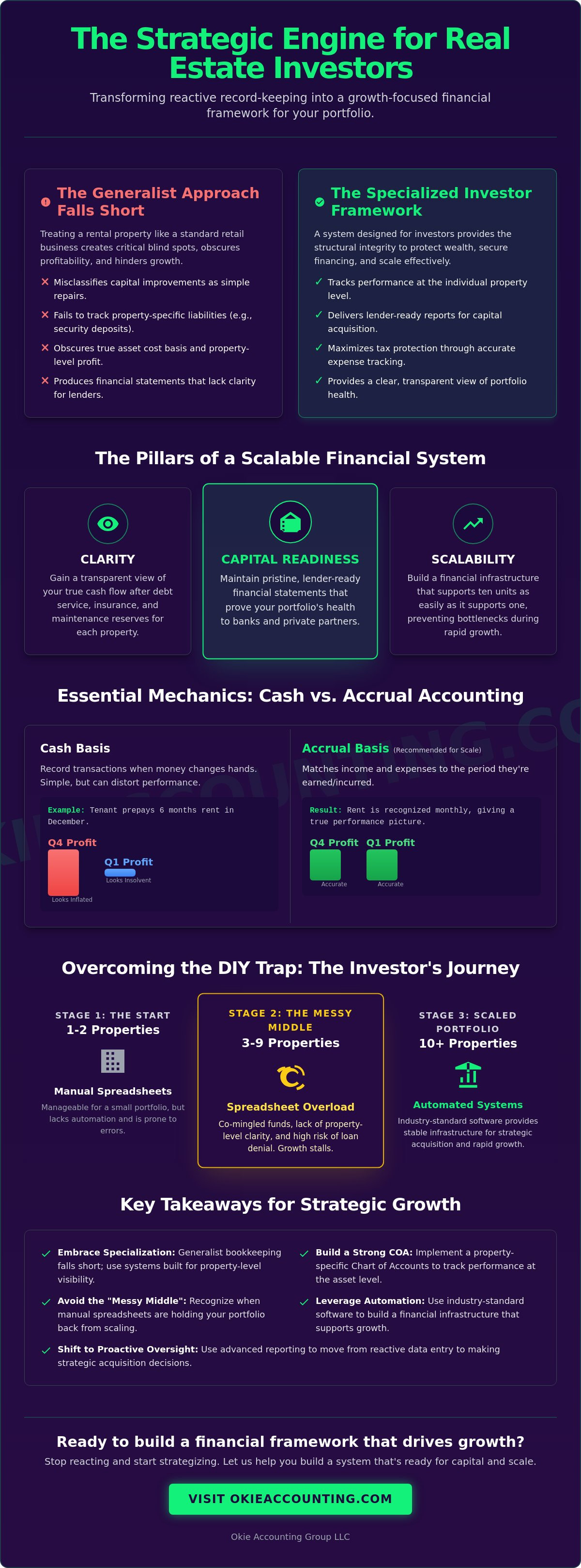
Generalist bookkeepers often treat a rental property like a standard retail business. This approach fails to capture the unique complexities of the industry. You aren't just selling a product; you're managing a depreciating asset with multiple income streams and property-specific liabilities. If you're handling renovations, project-based tracking is essential. Without a specialized system, it's easy to misclassify a capital improvement as a simple repair. This error doesn't just mess up your books; it obscures the true cost basis of your asset and can lead to significant issues during a portfolio audit or sale.
Specialized systems account for the "messy" details that generalists overlook. This includes tracking tenant security deposits as liabilities rather than income, managing escrow accounts for property taxes, and reconciling common area maintenance (CAM) charges. When you prioritize specialized accounting for real estate investors, you're investing in the longevity of your portfolio by ensuring every dollar is accounted for within its specific context.
The Core Objectives: Profit Protection and Scalability
A professional system rests on three pillars: compliance, clarity, and capital readiness. While basic record-keeping might keep you compliant, clarity and capital readiness are what drive growth. Accurate data prevents "profit leak" by capturing every deductible expense, from small maintenance calls to major structural upgrades. This level of detail is what transforms your financial statements from a historical record into a strategic tool.
Clarity: You gain a transparent view of your true cash flow after debt service, insurance, and maintenance reserves.
Capital Readiness: You maintain lender-ready financial statements that prove your portfolio's health to banks and private partners.
Scalability: You build a financial infrastructure that supports ten units as easily as it supports one.
Strategic financial oversight moves beyond the administrative task of recording history. It uses current data to predict future cash flow and identify the right moment for your next acquisition. By treating your accounting as a foundational system, you transition from a landlord who reacts to problems to an investor who manages a high-performing, data-driven enterprise.
Essential Mechanics: Organizing Your Financial Infrastructure
Establishing a rigorous financial infrastructure is the next step in building your structural framework. Without a disciplined approach to the mechanics of accounting for real estate investors, even the most promising portfolio can collapse under the weight of disorganized data. You need a system that distinguishes between simple cash flow and long-term asset health. This requires moving beyond basic spreadsheets and adopting a professional methodology that ensures every transaction serves a strategic purpose.
Choosing Between Cash and Accrual Basis
Most small-scale investors begin with cash basis accounting because it's simple. You record income when the check clears and expenses when you pay the bill. This provides immediate visibility into your bank balance. However, as your portfolio grows, cash basis can distort your true performance. Accrual basis accounting matches income to the period it was earned and expenses to the period they were incurred. If a tenant prepays six months of rent in December, cash basis makes you look incredibly profitable in Q4 but insolvent in Q1. Accrual basis smooths these fluctuations, providing a clearer picture for Strategic Real Estate Investment decisions. You should consider transitioning to accrual accounting once you manage multiple properties or seek complex financing.
Building a Property-Specific Chart of Accounts
Your Chart of Accounts (COA) is the backbone of your reporting. A generic COA won't suffice; you need categories specifically tailored to the industry. This includes granular accounts for rental income, mortgage interest, property insurance, and specific utility types. To maintain structural integrity, you should implement class tracking. This allows you to tag every transaction to a specific property, enabling you to run a Profit and Loss statement for each individual asset. Learning how to track expenses for rental properties through a structured COA ensures that no cost is lost in the shuffle. If your current setup feels cluttered, a professional QuickBooks Setup can provide the clarity you need to scale.
Tracking Depreciation and Capital Expenditures
Depreciation is a powerful non-cash expense that protects your taxable income by reflecting the gradual wear and tear of the property over its 27.5-year useful life. However, you must carefully distinguish between repairs and improvements. Repairs are operating expenses that keep the property in its current state, like fixing a leaky faucet. Improvements, or Capital Expenditures (CapEx), add value or extend the life of the asset, such as replacing a roof. Properly capitalizing these costs increases your property's cost basis. This is vital for reducing your future capital gains tax when you eventually sell. Tracking these mechanics accurately ensures you aren't just recording history, but actively protecting your future profits.
Overcoming the DIY Trap in Portfolio Management
Many investors begin their journey with a single property and a simple belief: "I can do this myself with a spreadsheet." At the start, manual tracking feels manageable. However, as you add doors to your portfolio, you inevitably enter the "messy middle." This is the volatile phase where your portfolio outgrows basic manual tracking, but you haven't yet implemented a scalable financial infrastructure. Without specialized accounting for real estate investors, this stage is characterized by decision fatigue and a constant underlying anxiety about the accuracy of your numbers. You cannot build a skyscraper on a residential foundation; likewise, you cannot scale a multi-million dollar portfolio on a static document.
The Hidden Costs of Co-mingled Funds
Mixing personal and business finances is perhaps the most dangerous habit a growing investor can develop. When you pay for a property repair with a personal credit card or deposit rent into a personal checking account, you pierce the "corporate veil." This administrative shortcut can have devastating legal consequences, potentially exposing your personal assets to business-related liabilities. If your entity's structural integrity is compromised, the legal protections you worked to establish may vanish when you need them most.
The administrative cost is equally high. Reconstructing co-mingled records during a tax audit is a grueling, time-consuming process that often leads to missed deductions and increased professional fees. To maintain profit protection, you must establish a dedicated bank account and credit card for every entity or portfolio. This separation ensures that your Financial Reporting remains untainted and your digital documentation is always ready for scrutiny. Clear boundaries aren't just about organization; they're about protecting the wealth you've built.
Why Spreadsheets are the Enemy of Scalability
Spreadsheets are inherently fragile. They rely on manual data entry, which carries a high risk of human error. A single mistyped digit or a broken formula can ripple through your entire portfolio, leading you to believe a property is performing better or worse than it actually is. Spreadsheets also lack the ability to provide real-time visibility. By the time you sit down to update your manual logs, the data is already historical rather than actionable.
Transitioning to cloud-based systems like QuickBooks Online is a requirement for modern accounting for real estate investors. These platforms offer automated bank feeds that pull transactions directly from your financial institutions, reducing manual entry errors and saving dozens of hours each month. When your accounting system integrates directly with your property management software, you gain a dynamic view of your portfolio health. This shift from manual labor to automated oversight allows you to focus on strategic growth rather than administrative maintenance.
Implementing a Scalable Accounting System for 2026
The transition from manual tracking to a professional system isn't just an upgrade; it's a requirement for survival in a "higher-for-longer" interest rate environment. In 2026, successful accounting for real estate investors relies on QuickBooks Online (QBO) as the industry standard. It provides the structural integrity needed to manage multiple properties without increasing your administrative burden. By moving to a cloud-based framework, you ensure that your data is accessible, secure, and ready for the strategic oversight required to protect your profits.
Leveraging Cloud Technology and Automation
Automation is the cornerstone of a modern financial infrastructure. You can set up automated bank rules to categorize recurring rental income and mortgage payments instantly. This reduces the time spent on data entry and minimizes the risk of human error. Digital receipt capture is equally vital. By scanning maintenance invoices immediately, you create a permanent audit trail that ensures every deduction is documented. This level of organization creates a natural synergy with remote Fractional Controller Services, allowing experts to monitor your portfolio's health in real time without the need for physical paperwork. If you need help building this foundation, our QuickBooks Setup & Training can streamline your transition to a professional system.
Key Metrics Beyond the Monthly Rent Check
To scale effectively, you must look past the balance in your checking account and focus on the KPIs that drive property valuation. Lenders and partners don't just look at gross income; they look at the metrics that prove your operational efficiency.
Net Operating Income (NOI): This is your total income minus operating expenses. It's the primary figure used to determine property value and cap rates.
Debt Service Coverage Ratio (DSCR): Lenders obsess over this ratio, which is your NOI divided by your annual debt service. Maintaining a DSCR above 1.20 is often the benchmark for securing favorable financing terms.
Cash-on-Cash Return: This metric measures your annual pre-tax cash flow against the total cash you've invested. It's the ultimate scorecard for how hard your capital is working.
Monthly Financial Reviews: The Strategic Habit
Data is only valuable if it's interpreted. You should establish a 30-minute monthly routine to review your Financial Reporting, specifically your Balance Sheet and Profit and Loss statement. This habit allows you to identify "red flag" variances, such as a sudden spike in utility costs or an unexpected rise in maintenance expenses. By performing regular Cash Flow Forecasting, you can prepare for upcoming vacancies or planned capital expenditures before they become crises. Viewing your financial statements as a scorecard ensures that every operational choice aligns with your long-term strategic goals.
Transitioning from Data Entry to Strategic Financial Oversight
Building a multi-million dollar portfolio requires more than just identifying distressed assets; it requires a disciplined financial infrastructure that supports high-level decision-making. Specialized real estate investor bookkeeping services function as a strategic partnership rather than a back-office utility. This shift allows you to move beyond the reactive task of recording history and into the proactive world of strategic oversight. When your financial data is organized within a professional framework, it stops being a burden and starts being the engine that drives your expansion.
When to Hire a Fractional Controller
There is a specific point in every investor's journey where the complexity of the portfolio outpaces the capabilities of basic record-keeping. Common triggers for this transition include investing across multiple states, managing complex entity structures like Series LLCs, or entering a phase of rapid acquisition. A compliance-focused bookkeeper simply records what happened. In contrast, our Fractional Controller Services provide a strategic interpretation of that data. This level of oversight is essential for preventing costly structural mistakes, such as misallocating funds between entities or failing to recognize shifting debt-to-equity ratios that could stall your next deal. High-level oversight ensures your financial health remains stable as your business grows more complex.
Creating Lender-Ready Financials
In a market where 30-year mortgage rates hover around 6.62%, lenders are increasingly cautious about where they deploy capital. They require a professional financial package that includes accurate Balance Sheets, P&L statements, and detailed Financial Reporting on specific property performance. Consistent, high-quality reporting builds immediate trust with your banking partners. It signals that you have a rigorous handle on your accounting for real estate investors and that your business is a lower risk. When a lender sees that your records are managed through a specialized, disciplined framework, they're more likely to offer favorable terms. This level of financial readiness is the ultimate competitive advantage for the modern investor.
At Okie Accounting Group LLC, we position ourselves as your strategic partner. We build the foundational systems and provide the Monthly Bookkeeping needed so you can focus on building your portfolio. By delegating the complexities of financial oversight to experts who understand the unique mechanics of your market, you gain the clarity and confidence to make data-driven choices. Our goal is to transform your property data into a strategic financial engine that protects your profits and ensures you're always ready for the next opportunity.
Securing the Infrastructure for Your Next Acquisition
Your portfolio's growth depends on the strength of its foundation. By moving away from fragile spreadsheets and implementing a property-specific Chart of Accounts, you ensure that every transaction supports your long-term health. Specialized accounting for real estate investors isn't just about tracking rent; it's about building a framework that ensures lender readiness and profit protection. You now understand that high-level oversight and automated cloud systems are the tools that allow you to scale with confidence.
At Okie Accounting Group LLC, we bring specialized expertise in both the construction and real estate sectors to serve as your strategic partner. Our cloud-based systems provide national, real-time accessibility, while our Fractional Controller oversight ensures your data informs your next big move. Gain financial clarity with specialized real estate accounting services from Okie Accounting Group LLC. Transitioning to a professional system allows you to stop managing data and start managing your legacy. Your next acquisition deserves the clarity of a disciplined financial engine.
Frequently Asked Questions
Do I need a separate bank account for each rental property?
You should maintain a dedicated bank account for each legal entity or portfolio to maintain the corporate veil. While a separate account for every single property isn't always legally required if they are under one LLC, it simplifies property-level tracking and ensures your financial reporting remains untainted. This structure prevents co-mingling and makes it much easier to reconcile monthly statements for each asset without manual errors.
What is the difference between a repair and a capital improvement for taxes?
Repairs are operating expenses that keep a property in its current working condition, such as fixing a broken window or servicing an HVAC unit. Capital improvements are investments that add value, prolong the property's life, or adapt it to a new use, like a full kitchen remodel. Improvements must be capitalized and depreciated over the asset's useful life rather than deducted immediately in the current tax year.
How long should real estate investors keep their financial records?
You should keep your financial records for at least seven years after you sell the property to satisfy IRS requirements. Because real estate involves long-term depreciation and capital gains, maintaining records of the original purchase and all capital improvements is essential for calculating your cost basis accurately. Digital documentation is the most efficient way to store these files securely while ensuring national, real-time accessibility for your advisory team.
Can I use QuickBooks for real estate investment accounting?
QuickBooks Online is the industry standard for accounting for real estate investors due to its scalability and integration capabilities. When configured with a property-specific Chart of Accounts and class tracking, it allows you to monitor individual property performance within a single company file. Proper setup ensures that your automated bank feeds and third-party property management tools sync data accurately for high-level financial oversight.
What is the most important financial metric for real estate investors to track?
The Debt Service Coverage Ratio (DSCR) is the most critical metric for investors seeking to scale through financing. Lenders use this ratio to determine if the property's income can comfortably cover its debt obligations. While Cash-on-Cash return measures your personal investment efficiency, the DSCR proves your portfolio's structural integrity to banking partners, which is vital for securing favorable terms in a high-interest-rate environment.
How does bookkeeping for real estate differ from construction accounting?
Real estate accounting focuses on recurring rental income, long-term depreciation, and asset management. In contrast, construction accounting is project-based and emphasizes job costing, work-in-progress (WIP) tracking, and complex payroll management for various trades. Our specialized expertise in both sectors allows us to bridge this gap, ensuring that investors who also perform major renovations have a system that handles both operational and project-based data seamlessly.
What happens if I forget to track a property expense?
Forgetting to track a property expense leads to "profit leak" and an artificially inflated tax liability. If you don't document a legitimate maintenance cost or utility payment, you lose the ability to deduct that expense, which directly reduces your net cash flow. Using digital receipt capture and automated bank feeds within your accounting for real estate investors system ensures that every dollar is captured and protected for your year-end reporting.
Is it better to use cash or accrual accounting for rental properties?
Accrual accounting is superior for growing portfolios because it matches income and expenses to the period they actually occur. This provides a smoother, more accurate representation of your property's performance compared to cash basis, which can be distorted by prepayments or delayed bills. Transitioning to accrual accounting is a strategic choice that provides the clarity needed for complex financial reporting and long-term cash flow forecasting.



Comments