_edited_edited.jpg)

Real Estate Investor Bookkeeping Services: A Buying Guide for Scalable Growth

Updated: May 14
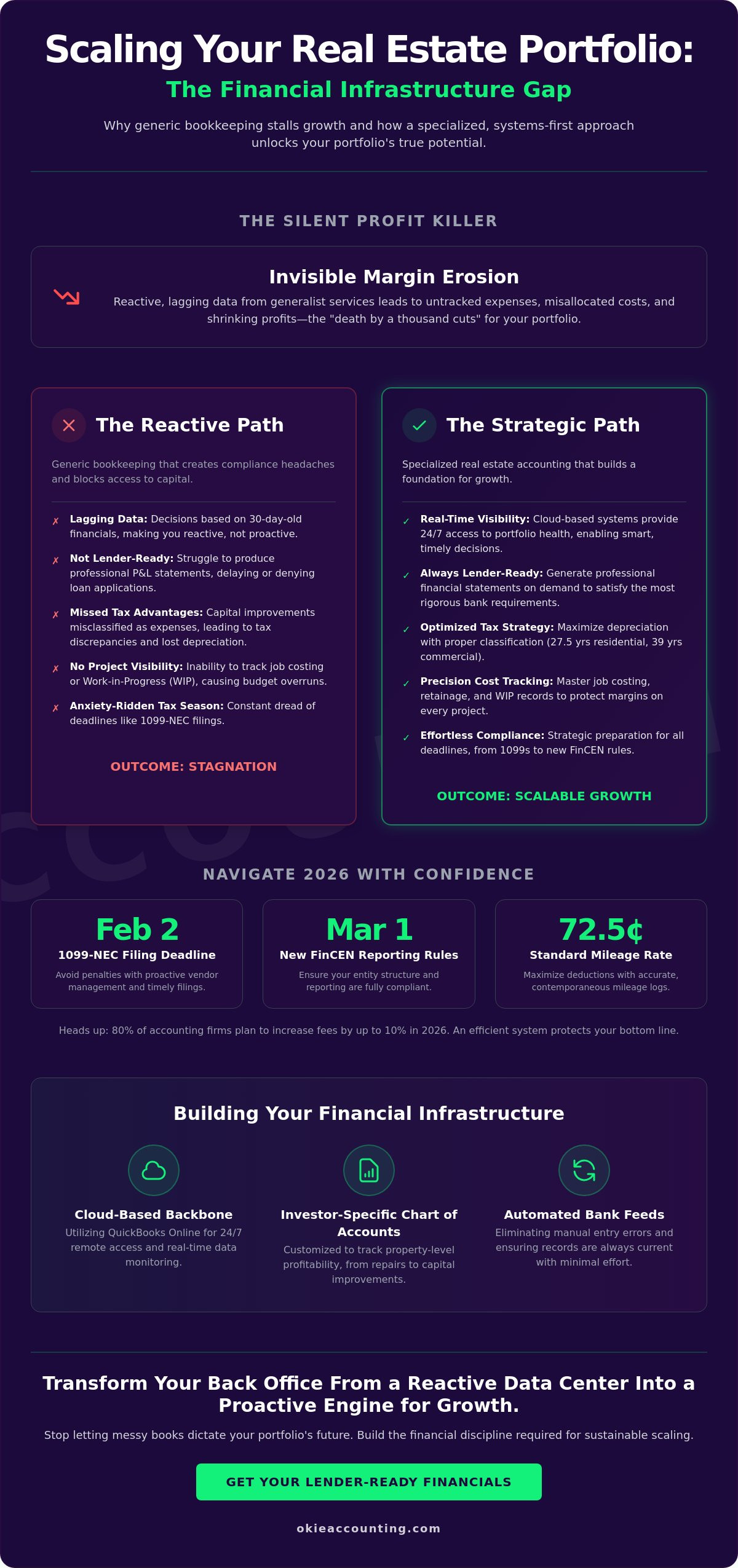
Why do most real estate portfolios stall exactly when they should be scaling? It isn't usually a lack of deals. Instead, it's the invisible erosion of margins that occurs when financial data is reactive rather than strategic. You've likely felt the anxiety of a looming February 2, 2026, deadline for 1099-NEC filings or the frustration of a lender asking for professional statements you don't have ready. Relying on generic real estate investor bookkeeping services that don't understand job costing or retainage tracking is a recipe for stagnation.
You likely agree that your time is better spent finding deals than reconciling bank statements. This guide will show you how to build a disciplined financial infrastructure that ensures you're always lender-ready and protected against margin loss. You'll learn how to move beyond basic data entry to gain real-time visibility into property-level profitability. We'll explore how to navigate the 2026 standard mileage rate of 72.5 cents per mile and the new FinCEN reporting rules effective March 1, 2026, ensuring your portfolio remains compliant and competitive.
Key Takeaways
Learn how specialized real estate investor bookkeeping services protect your margins by tracking property-specific capital improvements and complex retainage.
Discover the "systems-first" approach to building a financial infrastructure that provides real-time visibility into your portfolio’s health.
Identify non-negotiable provider skills like job costing and work-in-progress (WIP) tracking that generalist bookkeepers often overlook.
Master the transition from basic record-keeping to producing "lender-ready" financial statements that satisfy the most rigorous bank requirements.
Understand how a strategic accounting partner transforms your back office from a reactive data center into a proactive engine for sustainable growth.
Table of Contents
Beyond the Shoebox: Why Real Estate Investors Need Specialized Bookkeeping Services
Building Your Financial Infrastructure: The Systems-First Approach
Evaluating Real Estate Bookkeeping Providers: A Buying Guide
Maximizing ROI: Turning Clean Books into Lender-Ready Financials
Strategic Partnership: How Okie Accounting Group LLC Scales Your Portfolio
Beyond the Shoebox: Why Real Estate Investors Need Specialized Bookkeeping Services
Professional growth in Real estate investing demands a shift from casual record-keeping to a disciplined financial infrastructure. Specialized real estate investor bookkeeping services are not merely about logging receipts; they represent a systematic approach to tracking property-specific income, expenses, and capital improvements. This level of oversight ensures that every dollar spent is categorized correctly. It protects your margins from the "death by a thousand cuts" that occurs when expenses go untracked or misallocated across a growing portfolio.
Generalist bookkeepers often lack the industry-specific vocabulary required for complex portfolios. They frequently miss the nuances of retainage tracking or progress billing, which are essential for managing construction-heavy investments. When project costs aren't tracked with precision, you're left with lagging data. In a market where 80% of accounting firms are increasing their fees by up to 10% in 2026, you cannot afford to pay for services that don't provide a proactive advantage. Lagging data is a silent profit killer. If you only see your financial health 30 days after the month ends, you're making decisions based on the past, not the present.
The High Cost of Generalist Accounting
Misclassifying capital expenditures as operational expenses is a common error that leads to significant tax discrepancies. Without the disciplined oversight of a specialized partner, margin erosion becomes inevitable as project costs balloon without real-time visibility. Generalists often fail to maintain work-in-progress (WIP) records, making it impossible to determine if a specific renovation is staying within budget. Clean, accurate books are the absolute prerequisite for higher-level fractional controller services. You can't build a strategic forecast on a foundation of messy or incomplete data.
Signs You Have Outgrown Your Current Setup
If you feel a sense of dread as the February 2, 2026, deadline for 1099-NEC filings approaches, your current system has already failed you. An anxiety-ridden tax season is the clearest indicator that your real estate investor bookkeeping services are reactive rather than strategic. You should be able to identify property-level ROI at a glance without digging through spreadsheets. If you struggle to provide professional, lender-ready P&L statements during a loan application, you've outgrown your "shoebox" methods. Scalable growth requires a partner who understands that your financial statements are your most powerful tool for securing future capital and protecting your hard-earned margins.
Building Your Financial Infrastructure: The Systems-First Approach
Scalable growth isn't a byproduct of luck; it's the result of a deliberate financial system. Many investors treat bookkeeping as a chore to be completed once a month. However, a systems-first approach treats your accounting as a living infrastructure. While traditional Bookkeeping, accounting, and auditing clerks focus on historical accuracy, specialized real estate investor bookkeeping services focus on future scalability. By integrating payroll and project tracking directly into your ledger, you eliminate the data silos that lead to margin erosion.
Cloud-Based Accounting for Real-Time Visibility
QuickBooks Online serves as the digital backbone for modern real estate portfolios. It provides 24/7 access to your data, which is essential for remote investors who need to monitor property performance from anywhere in the world. Automated bank feeds are a cornerstone of this system. They significantly reduce manual entry errors and ensure your records stay current with minimal human intervention. This cloud-based approach allows your financial infrastructure to grow seamlessly from one property to twenty without the technical limitations of localized software. With 80% of accounting firms planning to increase fees in 2026, having an automated, efficient system protects your business from rising operational costs.
The Investor-Specific Chart of Accounts
A generic Chart of Accounts is a liability for a serious investor. You must distinguish between minor repairs and major capital improvements to maximize your depreciation schedules. For residential properties, this usually means a 27.5-year schedule; commercial assets require 39 years. Your system must also track escrow accounts and security deposits with surgical precision to remain compliant with state regulations. This level of detail is why many investors benefit from construction bookkeeping services that handle the complexities of job costing and progress billing. Without these distinctions, you're likely overpaying in taxes or missing out on critical cash flow opportunities.
Integrating payroll into this core system is equally vital. When you pay a crew or a contractor, the expense should immediately reflect against the specific project or property. This prevents the common problem of project costs living in one spreadsheet while your bank balance lives in another. A unified system provides the real-time visibility needed to spot margin erosion before it becomes a crisis. If you're ready to move beyond basic spreadsheets, you can explore specialized setup options to ensure your financial foundation is solid.
Evaluating Real Estate Bookkeeping Providers: A Buying Guide
Selecting a partner to manage your portfolio's finances is a high-stakes decision. You aren't just hiring a clerk; you're selecting a strategic advisor who will safeguard your margins. While generalist firms might offer lower hourly rates, they often lack the technical depth to handle job costing or retainage tracking. Specialized real estate investor bookkeeping services should be evaluated on their ability to produce lender-ready financials that withstand the scrutiny of a rigorous bank application. In 2026, monthly retainers for standard services generally fall between $300 and $1,500, but price alone is a poor metric for quality.
Key Criteria for Your Search
Industry experience is your first filter. A qualified provider must speak the language of construction and real estate finance fluently. Ask them how they handle margin erosion or if they're prepared for the new FinCEN real estate reporting rules effective March 1, 2026. Their technology stack is equally critical. You need experts who are QuickBooks ProAdvisors, not novices learning the software on your dime. Look for a partner who offers fractional controller services rather than simple data entry. This ensures you receive proactive financial oversight instead of reactive reporting.
Red Flags to Avoid
Be wary of any service that doesn't ask to review your current Chart of Accounts during the discovery phase. This indicates a "one-size-fits-all" approach that will fail to track your property-level ROI accurately. Other red flags include:
Services that only provide reports annually for tax purposes rather than monthly or in real-time.
Providers who are unaware of the 2026 standard mileage rate increase to 72.5 cents per mile.
Generic firms that lack a dedicated focus on the unique mechanics of the real estate market.
Firms that compete solely on price, which often signals a commodity-level service rather than specialized expertise.
Proactive communication is far more valuable than a low monthly fee. A proactive partner identifies potential cash flow bottlenecks before they occur. They ensure your books are always audit-ready and lender-ready, providing a level of stability that a bargain-bin bookkeeper cannot match. Accuracy and long-term stability should always outweigh short-term cost savings when building your financial infrastructure.
Maximizing ROI: Turning Clean Books into Lender-Ready Financials
Clean books are the baseline for compliance, but lender-ready financials are the engine for your portfolio's expansion. Many real estate investor bookkeeping services focus solely on recording past events. True financial infrastructure, however, prepares you for future opportunities. When a lender requests your financial package, they aren't looking for a messy pile of receipts or a basic spreadsheet. They require professional statements that satisfy rigorous bank requirements. This includes accurate Balance Sheets that reflect your true equity position and debt obligations without ambiguity.
Accurate Work-in-Progress (WIP) records are a critical component of your borrowing power. If you have multiple renovations or developments underway, your books must reflect the value added to those assets in real-time. Banks look for these disciplined records to assess your liquidity and management capabilities. With 80% of accounting firms planning to increase their fees in 2026, the value of having a system that generates these reports automatically cannot be overstated. High-quality data reduces the time spent on loan applications and increases your credibility with capital partners.
The Power of Fractional Controller Oversight
A Fractional Controller acts as a strategic mentor for your business. While a bookkeeper records transactions, a controller interprets the data to identify trends before they manifest as cash flow crises. They utilize budgeting and forecasting tools to determine exactly when you can afford your next acquisition or major renovation. This proactive partnership ensures that your growth is sustainable rather than accidental. By maintaining this high level of oversight, you protect your business from the margin erosion that often plagues investors who scale too quickly without adequate financial guardrails.
Reports Every Investor Needs Monthly
To maintain real-time visibility into your portfolio, you must review specific reports every thirty days. These documents provide the clarity needed for informed decision-making:
Property-Level Profit & Loss (P&L): This report allows you to identify underperforming assets and pinpoint exactly where expenses are exceeding projections.
Balance Sheet: A professional Balance Sheet provides a snapshot of your equity, debt, and overall net worth, which is essential for securing new lines of credit.
Cash Flow Forecasts: These are vital for planning upcoming capital improvements and ensuring you have the reserves to handle unexpected vacancies or repairs.
Transitioning from basic data entry to high-level financial oversight is the most effective way to maximize your ROI. If you're ready to upgrade your financial system, you can explore our Fractional Controller Services to gain the strategic insight your portfolio deserves. Moving beyond the "shoebox" method allows you to focus on finding the next deal while your financial infrastructure provides the stability you need to close it.
Strategic Partnership: How Okie Accounting Group LLC Scales Your Portfolio
Okie Accounting Group LLC doesn't just record transactions; we build the financial systems that drive sustainable growth. Led by Sarah O’Quinn, our firm provides the specialized real estate investor bookkeeping services necessary to navigate a volatile market. We act as a strategic mentor rather than a back-office vendor. This distinction is critical for investors who want to scale without losing control of their margins. By providing nationwide, remote financial leadership, we ensure your portfolio has the oversight it needs regardless of where your properties are located. Our expertise in construction and real estate finance allows us to speak your language from day one.
Our Proactive Process
Our methodology begins with a systems-first approach. We provide specialized QuickBooks setup and training to ensure your internal team understands the infrastructure we build. This isn't a one-time event. It's a continuous discipline of monthly bookkeeping that ensures data accuracy at every level. As your firm grows, we facilitate a seamless transition to fractional controller services. This higher level of oversight allows you to move from simply tracking costs to predicting future cash flow with confidence. We handle the technical complexities of retainage tracking and progress billing so you can stay focused on acquisition and development.
Lender-ready financials are not a luxury; they are a requirement for high-growth firms. We ensure your Balance Sheets and P&L statements are prepared to satisfy the most rigorous bank applications. This proactive stance eliminates the stress of last-minute scrambles during loan applications or tax deadlines. You gain a partner who understands the nuances of current industry regulations and reporting requirements. This creates an atmosphere of trust, where you feel your complex financial needs are understood by experts who value long-term stability and accuracy.
Ready for Financial Clarity?
It's time to move beyond the anxiety of shoebox accounting and reactive data entry. Professional oversight provides the peace of mind you need to present your business to lenders with quiet confidence. You deserve a partner who is as invested in your success as you are. Building a lender-ready financial infrastructure is the most important step you can take toward long-term stability. If you're ready to gain real-time visibility into your portfolio, you should Schedule a consultation with Okie Accounting Group LLC today. Let's build a system that works for you.
Secure the Financial Foundation of Your Portfolio
Building a scalable real estate portfolio requires more than just finding the right deals. It demands a disciplined financial infrastructure that transforms raw data into strategic insight. You've seen how a systems-first approach prevents margin erosion and how specialized job costing ensures your borrowing power remains intact. With 80% of accounting firms planning fee increases in 2026, securing a specialized partner now is a prudent move for your long-term stability.
Investing in professional real estate investor bookkeeping services allows you to focus on your core competency: finding and closing deals. Our team brings QuickBooks Certified ProAdvisor expertise and a specialized focus on construction and real estate to every partnership. We provide nationwide remote service capability, ensuring that your financial oversight is proactive and your statements are always lender-ready. You don't have to navigate complex regulations or the 2026 tax deadlines alone.
Ready to gain real-time visibility into your property-level profitability? Get Started with a Strategic Financial Review and build the foundation your growth deserves. The clarity you gain today will be the catalyst for your success tomorrow.
Frequently Asked Questions
What is the difference between general bookkeeping and real estate investor bookkeeping?
General bookkeeping records basic transactions; real estate bookkeeping tracks property-specific income, capital improvements, and escrow accounts. It requires a deep understanding of depreciation schedules and job costing to prevent margin erosion. This specialized approach ensures that every renovation expense is allocated correctly to the right asset, providing a level of detail that generalists often miss.
How much do real estate investor bookkeeping services typically cost?
According to 2026 industry data, small investors with 1 to 5 properties typically pay $200 to $500 per property for monthly bookkeeping. Hourly rates for professional bookkeepers range from $30 to $90. Mid-size portfolios with 6 to 20 properties often see monthly retainers between $1,500 and $3,000 to maintain a disciplined financial infrastructure.
Can you help with QuickBooks setup for a new real estate investment firm?
Yes, we provide comprehensive QuickBooks setup and training tailored specifically for real estate firms. This "systems-first" approach ensures your Chart of Accounts is configured to track capital improvements and security deposits correctly from day one. Choosing specialized real estate investor bookkeeping services for your setup is the foundation for generating the real-time visibility needed to scale.
Do I need a local bookkeeper, or is a remote service like Okie Accounting Group LLC better?
Remote services like Okie Accounting Group LLC offer specialized expertise that local generalists often lack. Our nationwide remote capability provides access to professionals who understand retainage and WIP tracking regardless of your location. This ensures your financial leadership is specialized in your niche rather than being limited by the small talent pool in your immediate geography.
How do specialized bookkeeping services help with my taxes?
Specialized real estate investor bookkeeping services ensure your records are organized and accurate for your tax professional. By maintaining clean books throughout the year, you avoid the stress of the February 2, 2026, 1099-NEC deadline. While we don't provide income tax preparation, our lender-ready financials make the filing process seamless and prevent costly classification errors.
What are "lender-ready" financial statements, and why do I need them?
Lender-ready statements are professional financial reports that satisfy the rigorous requirements of banks and private lenders. These include accurate Balance Sheets and property-level P&Ls that demonstrate your equity and debt positions clearly. Having these ready is a major competitive advantage when you are applying for financing to expand your portfolio or secure new acquisitions.
Can a bookkeeper help me track expenses for multiple rental properties separately?
Yes, a specialized bookkeeper uses a class tracking or location tracking system within QuickBooks to monitor each property separately. This allows you to see the ROI for every individual asset at a glance. It's essential for identifying underperforming properties and making informed decisions about which specific assets in your portfolio you should hold or sell.
What is fractional controller service, and when does an investor need it?
A fractional controller service provides high-level financial oversight and strategic mentoring beyond basic data entry. Investors typically need this when they reach a level of complexity where they require cash flow forecasting and budgeting to manage growth. It's the transition from looking at past transactions to planning for future acquisitions with the guidance of a disciplined partner.



Comments