_edited_edited.jpg)

How to Track Expenses for Rental Properties: A Scalable System for 2026

Updated: May 16
What if the pile of receipts on your desk isn't just a minor headache, but the single biggest obstacle to your next property acquisition? You likely started your portfolio to build long-term wealth, not to spend your weekends reconciling bank statements or hunting for lost rehab receipts. It's frustrating to watch your time disappear into manual entry, especially when you're worried about the risks of mixing personal and business funds. Understanding how to track expenses for rental properties is not just a seasonal chore; it is the structural framework required to protect your profit margins and secure future financing.
We understand that as your portfolio grows, your financial systems must evolve to keep pace. You deserve a clear, audit-proof record-keeping system that provides accurate monthly P&L statements without the stress of missing documentation. In this guide, we'll demonstrate how to transform messy data into a professional financial framework.
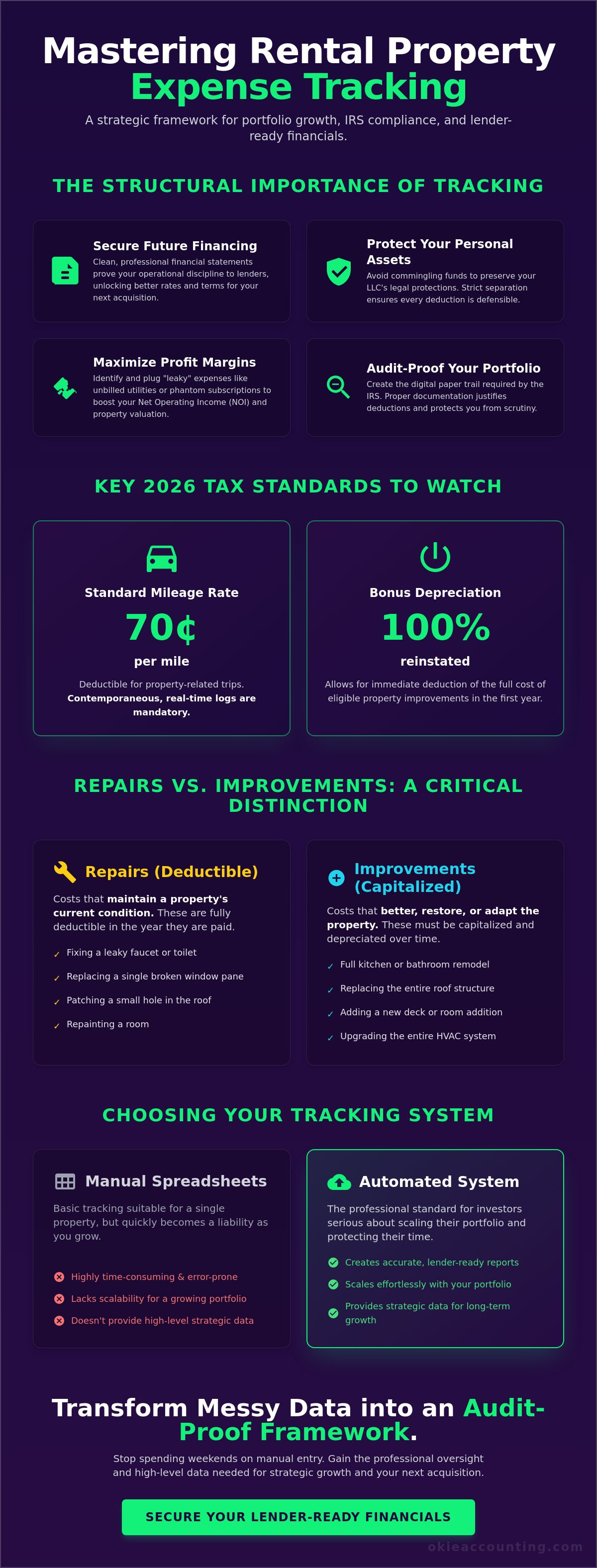
We'll explore the latest 2026 standards, such as the 70-cent mileage rate and the reinstated 100% bonus depreciation, to ensure your portfolio is positioned for maximum stability and growth.
Key Takeaways
Establish a structural framework that moves beyond basic record-keeping to create the lender-ready financials required for your next acquisition.
Master the critical distinction between deductible repairs and capitalized improvements to ensure your portfolio remains both compliant and profitable.
Implement a scalable system for how to track expenses for rental properties by utilizing digital capture and automated categorization workflows.
Evaluate the transition from manual spreadsheets to professional oversight to gain the high-level data needed for long-term strategic growth.
Table of Contents
The Structural Importance of Rental Expense Tracking
Financial clarity is the bedrock of a scalable real estate business. Many property owners view bookkeeping as a reactive task performed a couple of times each year; however, mastering how to track expenses for rental properties is actually a proactive strategy for financial readiness. It marks the transition from a passive landlord to a strategic real estate investor who treats their portfolio like a high-performance business. When you build a foundational system for your data, you're not just recording history. You're preparing for the future.
Accurate data is your most powerful tool for securing competitive terms with lenders. When you approach a bank for your next acquisition, they don't just look at the property's potential. They examine your operational history. Clean, professional financial statements prove you have the discipline to manage debt and maintain assets. Without these systems, you're essentially flying blind, unable to prove your portfolio's true health. Lenders prioritize stability, and organized books provide the confidence they need to offer better rates.
One of the most dangerous mistakes an investor can make is commingling personal and business funds. Mixing these accounts doesn't just create a mess for your bookkeeper; it can destroy the legal protections of your LLC. By maintaining a strict separation of funds and following standard methods of bookkeeping, you preserve the structural integrity of your business. This discipline protects your personal assets from professional liabilities while ensuring every deduction is defensible.
Protecting Your Profit Margins
Identifying leaky expenses is the first step toward maximizing your cash flow. Without granular tracking, small costs like recurring software subscriptions, unbilled utilities, or minor maintenance creep can quietly erode your margins. Strategic investors use this data to make informed decisions on rent increases based on actual overhead growth rather than guesswork. This level of detail directly impacts property valuations. Because commercial and multi-family values are often tied to Net Operating Income, every dollar you save through better tracking translates to a higher valuation for your portfolio.
Audit-Proofing Your Portfolio
The IRS places the burden of proof squarely on the taxpayer. In 2026, the emphasis on contemporaneous documentation means that real-time record keeping is no longer optional. Digital trails are essential for justifying deductions like the 70-cent mileage rate or the reinstated 100% bonus depreciation. Learning how to track expenses for rental properties with precision helps you avoid common red flags, such as disproportionate repair costs or undocumented travel. Establishing these internal controls now ensures that your portfolio remains resilient against scrutiny, regardless of how large it grows.
Categorizing Expenses: IRS Compliance vs. Strategic Management
Effective bookkeeping requires a Chart of Accounts that mirrors your actual operations while aligning with tax obligations. While many generalist guides focus solely on mapping transactions to Schedule E categories, strategic investors recognize that these broad buckets don't provide enough data for portfolio growth. Mastering how to track expenses for rental properties involves a dual-layered approach. You must satisfy the IRS requirements for compliance while simultaneously building a project-based tracking system that monitors the health of individual assets and your overall overhead.
A critical distinction in your record-keeping is the separation of property-specific costs from portfolio-wide overhead. If you own a multi-unit property, tracking expenses at the unit level allows you to identify which parts of the asset are underperforming. Without this granularity, a single problematic unit can hide within the overall property's profit and loss statement. If you're struggling to organize these accounts, professional QuickBooks setup and training can provide the structural foundation needed to manage complex data across multiple properties.
Operating Expenses (OpEx) for Daily Management
Operating expenses are the recurring costs required to keep your properties functional and occupied. This includes property taxes, insurance, and utilities, as well as professional fees for property management or legal counsel. For the 2026 tax year, maintaining a contemporaneous log for travel is vital. You can deduct 70 cents per mile for property-related trips, but the IRS requires real-time documentation to support these claims. Following IRS guidance on rental expenses ensures that your daily management costs remain defensible during an inquiry. Remember that repairs, which keep a property in its ordinary efficient operating condition, are fully deductible in the year you pay for them.
Capital Expenditures (CapEx) and Depreciation
Major renovations and rehab projects require a different accounting treatment than routine maintenance. These are capital expenditures that add value or extend the life of the property. For 2026, residential rental property is typically depreciated over a 27.5-year schedule. However, with the reinstatement of 100% bonus depreciation for qualifying property acquired after January 19, 2025, many investors can accelerate these deductions. Tracking these projects, such as an HVAC installation by E.R.S. Heating & Cooling, requires a "Work in Progress" (WIP) account to capture all costs before the asset is placed in service. This level of detail is essential for cost segregation studies, which can reclassify 20 to 40% of a property's components for even faster depreciation, significantly boosting your first-year cash flow. Understanding how to track expenses for rental properties with this level of precision is what separates a passive landlord from a strategic investor.
Manual vs. Automated: Choosing Your Tracking System
Choosing the right methodology for how to track expenses for rental properties depends on your current portfolio size and your long-term growth objectives. Many investors begin with the "Pile Method," which involves saving physical receipts and reconciling them at the end of the year. This approach is a significant liability. Thermal paper receipts fade over time, making them useless during an audit, and physical storage offers zero visibility into your real-time financial health. Relying on paper means you're always looking backward rather than making proactive decisions based on current data.
Evaluating the ROI of professional software versus manual labor hours is a critical step for any serious investor. If you spend several hours each month manually entering data, you're sacrificing time that could be spent analyzing new deals or managing tenant relationships. Transitioning to an automated system isn't just about convenience; it's about building a structural framework that supports a growing business. Automation reduces the friction of record-keeping and ensures your financial data is always ready for a lender's review.
The Spreadsheet Stage: When It Works
A customized Excel or Google Sheets template can be an effective starting point for investors with only one or two properties and simple financing. At this stage, your financials are manageable enough that a manual ledger doesn't consume excessive time. Every rental property spreadsheet should include specific columns for the transaction date, vendor name, property identifier, and the account category as defined in Publication 527. Despite the low cost, spreadsheets carry a high risk of human error. One mistyped number or a broken formula can ripple through your entire workbook, leading to inaccurate P&L statements and potential compliance issues.
The Software Stage: Built for Growth
Cloud-based accounting, specifically QuickBooks Online, is the gold standard for scaling a real estate portfolio. The primary advantage of professional software is the ability to connect direct bank feeds. This feature automatically pulls transactions into your ledger, allowing you to categorize them with a few clicks rather than manual typing. Integrating your property management apps with your general ledger creates a unified ecosystem where rent rolls and maintenance costs sync seamlessly. For investors involved in complex renovations, leveraging QuickBooks training for contractors is essential. This specialized knowledge helps you track real estate rehabs with the same precision used by construction professionals, ensuring that every capitalized cost is captured correctly to maximize your depreciation benefits.
A 5-Step Monthly Workflow for Audit-Proof Books
Establishing a repeatable monthly workflow is the only way to master how to track expenses for rental properties without succumbing to administrative burnout. A structured process ensures that data is captured accurately, categorized correctly, and verified against actual bank activity. This discipline transforms your financial records from a simple list of costs into a strategic asset.
Follow these five steps to maintain a professional, audit-proof financial framework.
Step 1: Digital Capture. Scan every receipt the moment it's generated. Use a mobile accounting app like Hubdoc.com to capture the physical receipts before they fade or disappear. This creates an immediate digital trail that links directly to your ledger.
Step 2: Categorization. Assign every transaction to a specific property and account. If you manage multi-unit assets, ensure the expense is tied to the correct unit. This granularity is essential for identifying which properties are truly profitable.
Step 3: Reconciliation. Match your bank and credit card statements to your recorded transactions. This is the most critical step. It confirms that no expenses were missed and that your recorded cash flow perfectly mirrors your actual bank balance.
Step 4: Review. Generate a monthly Profit and Loss (P&L) statement for each property. Reviewing these reports monthly allows you to spot trends, manage overages, and maintain a clear view of your net operating income.
Step 5: Backup. Secure digital copies of all supporting documentation in a cloud-based environment. Organize these files by year and property to ensure they're easily accessible if an inquiry ever arises.
Capturing Receipts in the Field
Success in field capture starts with a dedicated business credit card. Mixing personal and business accounts makes it nearly impossible to maintain clean books. When handling contractor invoices or rare cash payments, request a digital receipt immediately. Standardize your file naming conventions, such as "YYYY-MM-DD_Vendor_Property_Amount," to make searching your digital archives effortless. If managing these granular details feels like a distraction from your growth goals, our monthly bookkeeping services can handle the heavy lifting for you.
The Power of the Monthly Financial Review
A monthly review is your early warning system. By comparing your "Budget vs. Actual" figures for renovation projects, you can stop cost overruns before they drain your reserves. This review also helps you identify unexpected utility spikes or vendor overcharges that might otherwise go unnoticed. When your data is consistently reviewed and reconciled, you provide a seamless handoff to your tax preparer, ensuring you maximize every available deduction without the typical year-end scramble. Understanding how to track expenses for rental properties with this level of rigor positions you as a sophisticated investor in the eyes of lenders and partners.
Scaling Your Portfolio with Professional Oversight
Growth creates a unique paradox for real estate investors. The more properties you acquire, the less time you have to manage the very data required to fund your next deal. While you may have mastered how to track expenses for rental properties using manual spreadsheets or basic software in your early days, scaling into a multi-asset portfolio requires a shift from administrative tasks to structural oversight. This is where the transition from DIY management to professional real estate investor bookkeeping services becomes a strategic necessity rather than a luxury.
Okie Accounting Group builds the financial infrastructure that allows you to step away from the ledger and focus on acquisition. We don't just record transactions; we construct a framework that protects your profits and ensures your business remains audit-proof. By moving beyond basic record-keeping, you gain the clarity needed to make data-driven choices about capital expenditures and portfolio expansion. This disciplined approach ensures that your financial data is an asset, not a liability, as you navigate the complexities of the 2026 market.
When to Outsource Your Rental Bookkeeping
You'll know it's time to outsource when your monthly reconciliation takes more than a few hours or when you're consistently late on generating P&L statements. If you're missing out on tax strategies like cost segregation or failing to track "Work in Progress" for rehabs, your DIY system is likely costing you more than the price of professional help. A specialized real estate bookkeeper understands the mechanics of your market, ensuring you reach "Lender-Ready" status. This means having a clean balance sheet and accurate income statements ready the moment a high-value opportunity appears. Lenders don't just want to see that you're profitable; they want to see that your profits are documented through a rigorous, professional system.
Strategic Partnership for Growth
True scaling requires moving beyond historical tracking into the realm of cash flow forecasting and proactive planning. A Fractional Controller acts as a strategic mentor, providing high-level analysis that software alone cannot offer. They help you understand the broader implications of your financial health, from debt-service coverage ratios to long-term portfolio stability. This level of partnership transforms your bookkeeping from a back-office burden into a growth engine. It ensures that as you add more units, your financial systems remain organized and predictable. Ready for a structural upgrade? Explore our Fractional Controller services to see how we can stabilize and grow your portfolio.
Secure Your Portfolio's Financial Future
Transitioning from a passive landlord to a strategic investor requires a fundamental shift in how you view your financial data. By implementing the rigorous monthly workflow and categorization standards discussed, you protect your profit margins and ensure your books remain audit-proof. Mastering how to track expenses for rental properties serves as the essential structural framework for a scalable business. This discipline allows you to approach lenders with the confidence required to secure the best terms for your next acquisition.
At Okie Accounting Group , we specialize in constructing these foundational systems for the real estate and construction sectors. Our cloud-based systems offer national accessibility, while our Fractional Controller oversight provides the strategic mentorship necessary for long-term stability. You don't have to manage the complexities of project-based tracking or multi-unit reconciliations alone. Gain Financial Clarity with Professional Real Estate Bookkeeping and position your portfolio for its next stage of growth. Your journey toward operational clarity and financial readiness starts with a single, disciplined step.
Frequently Asked Questions
What is the best way to keep track of rental property expenses?
The most effective method is implementing a cloud-based accounting system that integrates automated bank feeds with a project-based Chart of Accounts. This ensures every transaction is captured in real-time and linked to a specific asset. By using a professional platform like QuickBooks Online, you move beyond basic spreadsheets and build a scalable foundation that provides the granular data needed for strategic growth.
Can I use one bank account for multiple rental properties?
You can use one business account for multiple properties, but you must never mix business funds with personal ones. For superior oversight, many investors prefer separate accounts for each entity to simplify the reconciliation process. If you choose a single account, you must utilize class tracking or property-specific tags to maintain the structural integrity of your individual property profit and loss statements.
Are home office expenses deductible for rental property owners?
Yes, home office expenses are deductible if you use a portion of your home exclusively and regularly for your rental business. You must meet specific criteria, such as using the space as your principal place of business for administrative or management tasks. Documenting these costs accurately is part of a comprehensive strategy for how to track expenses for rental properties while protecting your overall profit margins.
How long should I keep receipts for my rental property?
You should keep all receipts and supporting documentation for at least three years from the date you file your original return. However, for property improvements or assets you depreciate, you must keep records for as long as you own the property plus three years. Digital storage is the preferred method for 2026, as it prevents physical degradation and ensures your records are always audit-ready.
What is the difference between a repair and an improvement for taxes?
A repair keeps your property in its ordinary efficient operating condition, such as fixing a leak or painting a room. An improvement adds value, prolongs the property's life, or adapts it to a new use, such as a roof replacement or a kitchen remodel. Repairs are generally deductible in the year they occur, while improvements must be capitalized and depreciated over time to reflect their long-term value.
How do I track mileage for my rental property business?
The most reliable method is using a GPS-enabled mileage tracking app that creates a contemporaneous log of every business trip. You must record the date, destination, business purpose, and total miles driven to satisfy record-keeping requirements. Consistent logging ensures you don't lose out on the 70-cent per mile deduction allowed in 2026, providing a defensible trail if your records are ever reviewed.
Should I use QuickBooks or a specialized property management app?
Strategic investors often use both, integrating a property management app for tenant interactions with QuickBooks for their general ledger. While management apps handle rent collection and maintenance requests, they often lack the robust financial reporting and fractional controller oversight needed for scaling. Using QuickBooks as your foundational system provides the professional-grade data that lenders and strategic partners expect to see.
What happens if I lose a receipt for a rental expense?
If you lose a receipt, you should attempt to obtain a duplicate from the vendor or use bank statements and cancelled checks as secondary evidence. However, the IRS may disallow deductions that lack contemporaneous documentation during an inquiry. To mitigate this risk, you should implement a digital-first capture system where you scan invoices immediately. This proactive approach ensures your record-keeping remains resilient even if physical copies are misplaced.



Comments