_edited_edited.jpg)

Fractional Controller Pricing: A 2026 Strategic Guide for Growing Firms

Your financial data isn't just a record of the past; it's the architectural blueprint for your firm's future growth. You've likely felt the sting of messy WIP reports or the persistent anxiety that your books are too late to drive real-time decisions. Clarity shouldn't be a luxury. It's difficult to scale when you're uncertain about project profitability or whether you're truly lender-ready.
Understanding fractional controller pricing is the first step toward replacing that chaos with a disciplined, scalable financial infrastructure.
We agree that you need more than just basic record-keeping; you need a strategic partner who understands the mechanics of your specific market. This guide will help you discover the specific factors driving the cost of high-level oversight and how to evaluate the ROI of structural financial health. We'll examine how specialized expertise and system complexity influence your investment, ensuring you gain the clarity and control necessary to protect your profits and fuel long-term stability.
Key Takeaways
Distinguish between administrative bookkeeping and strategic financial leadership to ensure your firm has the right level of oversight for growth.
Evaluate how industry-specific complexities in construction and real estate directly influence fractional controller pricing and service scope.
Compare the benefits of monthly retainers against hourly billing to find a model that provides predictable costs and proactive partnership.
Discover how to identify and plug "leaks" in project spending, turning your financial reporting into a powerful profit protection tool.
Learn how a cloud-based financial infrastructure creates the real-time clarity needed for lender-readiness and confident decision-making.
What is a Fractional Controller and Why Does Pricing Vary?
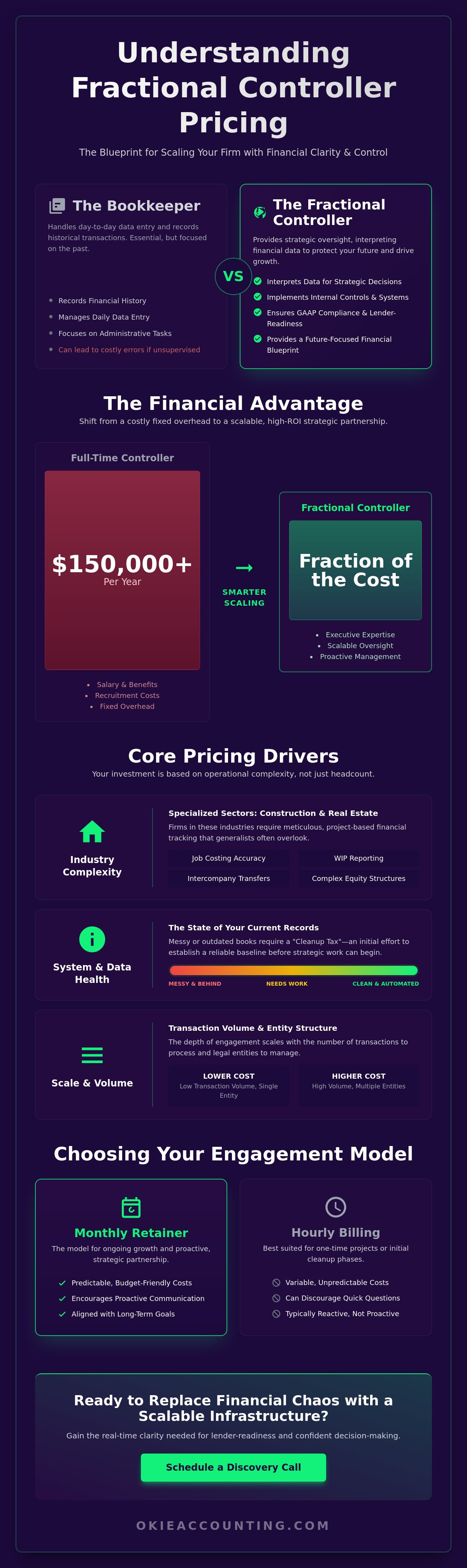
A fractional controller provides high-level oversight of your accounting function without the commitment of a full-time executive hire. This role ensures your financial data maintains structural integrity and remains compliant with GAAP standards. While a bookkeeper handles the day-to-day data entry, the controller manages the systems that produce those numbers. Because every firm has unique operational needs, fractional controller pricing typically varies based on the frequency of reporting and the complexity of your financial architecture.
Fractional executives allow growing firms to access specialized talent on a part-time basis. This model is particularly effective for businesses that have outgrown basic administrative support but aren't yet ready for a permanent C-suite salary. It bridges the gap between simple record-keeping and high-level strategic planning.
Controller vs. Bookkeeper: The Value Gap
The primary difference lies in the application of data. Bookkeeping records history, while controllers interpret that history to protect your future. In specialized sectors like construction, relying on the "cheapest" data entry option often leads to expensive errors in job costing and WIP reporting. A controller closes this gap by implementing internal controls designed to prevent fraud and financial leakage. They ensure that every dollar spent is tracked against a specific project, providing the accuracy required for lender-readiness.
The Strategic Advantage of Fractional Leadership
Hiring a full-time controller often requires a salary and benefits package exceeding $150,000. For many firms, this is an unnecessary overhead that drains capital better spent on operations. Our fractional controller services provide the same level of executive expertise at a fraction of that cost. This model offers incredible scalability. You can adjust the level of oversight as your firm takes on larger projects or enters new markets.
Transitioning to this level of leadership moves your firm from reactive data entry to proactive financial management. Instead of wondering why a project lost money three months after it closed, you'll have the systems in place to identify variance in real time. This proactive stance is essential for maintaining a healthy cash flow and building a scalable financial infrastructure that supports long-term stability. Understanding how fractional controller pricing scales with your business allows you to plan for growth without sacrificing the quality of your financial oversight.
Key Factors Influencing Fractional Controller Pricing in 2026
Determining the right investment for fractional controller pricing requires a look at the operational load rather than just a simple headcount. In 2026, geographic location has become less relevant as cloud-based oversight matures. Instead, the primary drivers are the complexity of your financial reporting and the integrity of your existing data. A firm managing multiple properties or complex construction projects requires a higher level of technical oversight to add real value to your operations. Your transaction volume and the number of legal entities being managed also dictate the depth of the engagement.
Structural integrity starts with understanding the weight of your specific industry requirements. When your business moves beyond basic administrative needs, the cost of the service reflects the specialized knowledge required to protect your margins. Professional oversight ensures that your financial infrastructure is not just functional, but scalable.
Industry-Specific Complexity: Construction and Real Estate
Construction and real estate firms face unique challenges that generalist providers often overlook. Job costing and project-based financial tracking require a meticulous approach to ensure that every expense is allocated correctly. In real estate, managing intercompany transfers and complex equity structures across multiple holdings adds layers of technical difficulty. Work in Progress (WIP) reporting serves as a critical profit protection tool that necessitates deeper technical analysis, naturally increasing the controller's involvement and the associated service value. This level of detail is what allows you to maintain lender-readiness and secure future bonding capacity.
System Readiness and Data Integrity
The state of your current financial records is a major factor in the initial cost of engagement. If your data is messy or behind, you'll likely face a "Cleanup Tax." This represents the intensive effort required to bring historical records up to GAAP standards before ongoing oversight can begin. Implementing a modern tech stack centered on QuickBooks Online can streamline costs through automation and real-time data syncs. If you're unsure if your current systems support high-level oversight, you can schedule a brief discovery call to evaluate your technical readiness.
A controller's role is to ensure your systems provide a clear, accurate picture of your financial health. This involves verifying that your technical stack supports robust reporting and internal controls. When your systems are optimized, the controller spends less time on manual corrections and more time on strategic analysis. This transition from cleanup to proactive management is where your firm realizes the most significant long-term stability.
Comparing Pricing Models: Hourly vs. Retainer vs. Value-Based
Selecting the right billing structure for your financial oversight is a strategic decision that directly impacts your firm's operational rhythm. While the primary goal is to gain clarity over your data, the way you pay for that expertise influences the depth of the partnership. In 2026, fractional controller pricing has evolved beyond simple time tracking to reflect the complex needs of growing firms. Most providers now offer a variety of models designed to align their services with your specific business outcomes and financial stability.
Structural integrity in your accounting function requires a model that encourages proactive management rather than reactive fixes. Whether you're navigating a short-term system implementation or seeking a long-term strategic mentor, the pricing structure should mirror the predictability you expect from your financial reports. Understanding these models allows you to choose a path that protects your profit margins while ensuring your systems remain scalable.
Hourly Rates: What the Market Dictates in 2026
Hourly billing remains a common entry point for firms that need specific, time-bound assistance. This model is often best for one-off projects, such as a QuickBooks setup or a targeted cleanup of historical data. However, hourly engagements often create a "meter's running" anxiety that can discourage the open communication needed for high-level oversight. It's common to see a wide range in rates between junior-level oversight and executive-level advisory. You should also watch for hidden costs in hourly models, such as administrative overhead or travel fees, which can make your monthly accounting spend unpredictable.
Fixed Monthly Retainers: The Preferred Choice for Growth
For firms seeking a true strategic partner, fixed monthly retainers have become the preferred standard. This model provides predictable monthly expenses, which simplifies your internal budgeting and cash flow management. Retainers move the relationship away from a vendor-client dynamic toward a disciplined partnership. Typical service tiers in a retainer often include:
Management of the monthly close process and GAAP compliance.
Oversight of payroll management and bookkeeping functions.
Regular strategic review meetings to analyze financial performance.
Continuous monitoring of internal controls and profit protection.
This structured approach ensures that your financial infrastructure is maintained with the same rigor as your physical assets. By removing the uncertainty of hourly billing, you allow your controller to focus on the long-term health of your firm rather than tracking minutes.
Value-Based and Hybrid Models
Value-based pricing is the most advanced model, aligning the fee directly with the business outcomes achieved, such as reaching specific profit targets or securing a certain level of bonding capacity. Hybrid models are also gaining traction. These often combine a base retainer for foundational services with project-based add-ons for intensive tasks like cash flow forecasting or complex debt restructuring. This flexibility ensures that your fractional controller pricing scales in direct proportion to the value and stability brought to your firm's financial architecture.
Assessing ROI: Why Controller Services are a Profit Protection Strategy
Viewing fractional controller pricing as a simple expense line item misses the broader strategic picture. High-level financial oversight is a profit protection mechanism designed to identify and plug "leaks" in your project spending and overhead. When your financial data is messy, you're likely losing money to unbilled change orders, vendor overcharges, or inefficient payroll allocations. A controller establishes the rigorous systems needed to catch these discrepancies before they erode your bottom line.
The return on investment often manifests in improved cash flow through disciplined accounts receivable and payable management. By tightening your billing cycles and optimizing vendor payments, a controller ensures you have the liquidity necessary for operational stability. Clean, GAAP-compliant financials also create lender-readiness. Banks and bonding companies view organized firms as lower risk, which can lead to lower interest rates and increased borrowing capacity. The cost of inaction is often far higher than the investment in oversight; unmonitored margins can cost a growing firm tens of thousands of dollars in lost profit annually.
Protecting Your Profit Margins
Using management accounting allows you to identify low-margin projects early in the construction or development cycle. Instead of waiting for a project to close to see if it was profitable, a controller provides the real-time visibility needed to make mid-course corrections. This proactive stance includes vetting vendor contracts for unfavorable terms and ensuring strict payroll compliance. Accurate financial reporting also ensures you aren't paying for clerical errors or missing out on industry-specific deductions due to poor record-keeping. If you want to see how these systems can stabilize your margins, request a discovery call to discuss your specific needs.
Preparing for Scale and Exit
A scalable financial infrastructure is essential for firms planning multi-state expansion or a future exit. Controllers build the foundational systems that allow your business to handle increased complexity without a corresponding increase in administrative chaos. They ensure your firm is "due diligence ready" at all times, making a potential sale or merger much smoother and more lucrative. If you're unsure about the timing of this investment, you can refer to our guide on when to hire a fractional controller. This strategic transition ensures that your growth is built on a stable, data-driven foundation rather than abstract theories or guesswork. Understanding how fractional controller pricing fits into your long-term health allows you to invest with confidence in your firm's structural integrity.
The Okie Accounting Group LLC Approach: Strategic Financial Partnership
At Okie Accounting Group LLC, we don't simply manage numbers; we construct the comprehensive structural frameworks that distinguish high-performing firms from those struggling with administrative chaos. Our deep specialization in construction and real estate ensures that we speak your language fluently. We understand the unique mechanics of your market, from complex job costing to the nuances of WIP reporting. By leveraging cloud-based systems, we deliver real-time financial clarity that allows you to lead with confidence. Our fractional controller services are designed to function as a strategic extension of your internal team, providing the disciplined oversight necessary for long-term health. This integration ensures that your staff has the support of an executive-level mentor who values accuracy and stability as much as you do.
A Disciplined Methodology for Financial Health
Our methodology is grounded in a proactive, step-by-step onboarding process. We first stabilize your books by identifying and correcting historical inaccuracies that often lead to anxiety over lender-readiness. Once your data is reliable, we shift our focus to optimization. This involves refining your internal controls and establishing a steady rhythm of monthly financial reviews. These reviews serve as a catalyst for data-backed decisions, moving your firm away from reactive data entry toward a proactive management stance. We prioritize profit protection at every level, ensuring that your investment in fractional controller pricing yields a scalable financial infrastructure that supports your firm's growth. This disciplined approach ensures that your complex needs are understood and addressed by experts who are as invested in your business's success.
Next Steps: Securing Your Financial Future
Securing your firm's financial future requires a commitment to accuracy and a forward-thinking partner. When you're ready to transition from basic record-keeping to strategic oversight, you can request a customized quote tailored to your firm's specific needs. To make the most of your initial consultation, we recommend having your current project lists and financial statements ready for a deep-dive discussion. We maintain a strict commitment to transparency in our fractional controller pricing, focusing on the strategic value we bring to your operations. There are no hidden fees or abstract theories, just a practical, disciplined approach to building a more stable and profitable business. This structured path takes you from a state of financial complexity to one of operational clarity and confidence, protecting your margins as you scale.
Building a Foundation for Scalable Financial Growth
Transitioning from basic record-keeping to professional oversight is a pivotal moment for any growing firm. You've seen that fractional controller pricing is an investment in your company's structural integrity rather than a mere administrative cost. By aligning your pricing model with your specific industry complexities, you ensure that your financial data remains a reliable tool for growth. Whether you're navigating complex job costing in construction or managing multi-entity real estate portfolios, the right framework protects your margins and prepares you for future scale.
Okie Accounting Group LLC brings specialized expertise to this transition. Led by Sarah O’Quinn, a veteran in project-based financial tracking, our team provides nationwide service with a focus on cloud-based efficiency. We speak the language of your niche and understand the mechanics required to stabilize your books. You don't have to manage these complexities alone. Take the next step toward operational clarity and profit protection today.
Schedule a Consultation to Discuss Your Strategic Financial Framework and discover how a disciplined partnership can secure your firm's future. We look forward to helping you build a more stable and profitable path forward.
Frequently Asked Questions
What is the average hourly rate for a fractional controller in 2026?
The standard range for controller-level advisory work in 2026 typically falls between $125 and $250 per hour. Highly specialized controllers or those performing executive-level tasks often command rates at the higher end of that spectrum. Most growing firms find that a fixed monthly retainer offers more predictability than these variable hourly charges. This allows for a more disciplined partnership focused on long-term stability rather than tracking billable minutes.
Does fractional controller pricing include software costs like QuickBooks?
Software subscriptions such as QuickBooks Online are generally treated as separate business expenses and aren't included in the service fee. While your controller manages the technical stack and ensures its structural integrity, the firm typically maintains direct ownership of the software licenses. This structure ensures you always have access to your historical data. It also allows for a clear distinction between administrative tools and professional oversight services.
How many hours a month does a fractional controller typically work?
A fractional controller typically provides between 5 and 15 hours of high-level oversight per month for a standard growing firm. This time is dedicated to managing the monthly close process, ensuring GAAP compliance, and reviewing strategic financial reports. If your business manages multiple entities or has a high transaction volume, the required hours may increase to maintain the necessary level of financial clarity and control.
Is there a setup or implementation fee for fractional controller services?
Most engagements involve an initial implementation or cleanup fee to stabilize your financial infrastructure. If your books require significant historical corrections to reach a lender-ready state, this fee covers the intensive work needed to build a reliable foundation. Establishing these systems correctly from the start ensures that your ongoing fractional controller pricing remains predictable. It also prevents messy data from compromising your future strategic decisions.
Can a fractional controller help with construction job costing and WIP?
Yes, a specialized controller is essential for managing the technical nuances of construction job costing and Work in Progress (WIP) reporting. These tasks require a deep understanding of project-based financial tracking that basic bookkeeping services don't provide. By accurately allocating costs and monitoring project margins in real time, a controller acts as a profit protection partner. This level of oversight is critical for maintaining bonding capacity and lender-readiness.
How does a fractional controller differ from a part-time CFO in terms of cost?
Fractional controllers generally require a lower investment than part-time CFOs because their focus is tactical and operational rather than purely strategic. While a CFO handles capital raises and long-term equity strategy, a controller ensures the accuracy and integrity of the financial data itself. For many firms with revenue under $10M, a controller provides the necessary structural framework at a more accessible price point than a high-level CFO.
Will hiring a fractional controller reduce my CPA fees at year-end?
Maintaining clean, reconciled financials throughout the year significantly reduces the time your external CPA must spend on year-end adjustments. When your books are already compliant with GAAP standards, the tax preparation process becomes much more efficient. This proactive management eliminates the need for expensive "emergency" cleanups during tax season. While we don't provide income tax preparation, our oversight ensures your tax professional receives a perfect data set.
What happens if my business grows—does the pricing scale with me?
Your service level and fractional controller pricing are designed to scale in direct proportion to your firm's complexity. As you take on larger projects, add more employees, or expand into new states, the depth of oversight can be adjusted to maintain stability. This flexibility allows you to access executive-level talent that evolves with your business. You gain a scalable financial infrastructure without the immediate need for a full-time executive salary.



Comments