_edited_edited.jpg)

When to Hire a Fractional Controller: A Strategic Guide for Growing Firms

Updated: May 18
You don't hire a fractional controller because you can't do the books; you hire one because your books can no longer support your growth strategy. For many construction and real estate firms, revenue often hits the $5 million mark before the cracks in the foundation start to show. You likely already feel the strain of margin erosion where profits shrink despite higher sales, or the frustration of being unable to produce lender-ready statements when a bonding agent calls. Knowing when to hire a fractional controller is the difference between reactive firefighting and proactive financial leadership.
It's common to feel like your financial data is a trailing indicator rather than a roadmap. At Okie Accounting Group LLC, we agree that recording transactions isn't enough when you need real-time visibility into project-based profitability. Since 72% of companies with revenues between $3 million and $15 million are now considering fractional services, you aren't alone in seeking better control. This guide will teach you the specific triggers and operational milestones that signal you are ready for high-level oversight. We will explore how a disciplined system scales your business, including a look at 2026 market trends and the $119,497 average salary benchmark for specialized financial talent.
Key Takeaways
Define the "Bookkeeper Ceiling" and understand why recording transactions is only a small fraction of a healthy financial infrastructure.
Identify the specific operational milestones, such as "Lender Anxiety" or a delayed monthly close, that signal exactly when to hire a fractional controller.
Compare the distinct roles of bookkeepers, controllers, and CFOs to build a disciplined team that matches your current revenue and complexity.
Learn how high-level oversight pays for itself by preventing margin erosion through accurate job costing and optimized cash flow management.
Recognize why specialized systems like WIP tracking and progress billing are non-negotiable for construction and real estate firms looking to scale.
Table of Contents
What is a Fractional Controller and How Does the Role Differ from Bookkeeping?
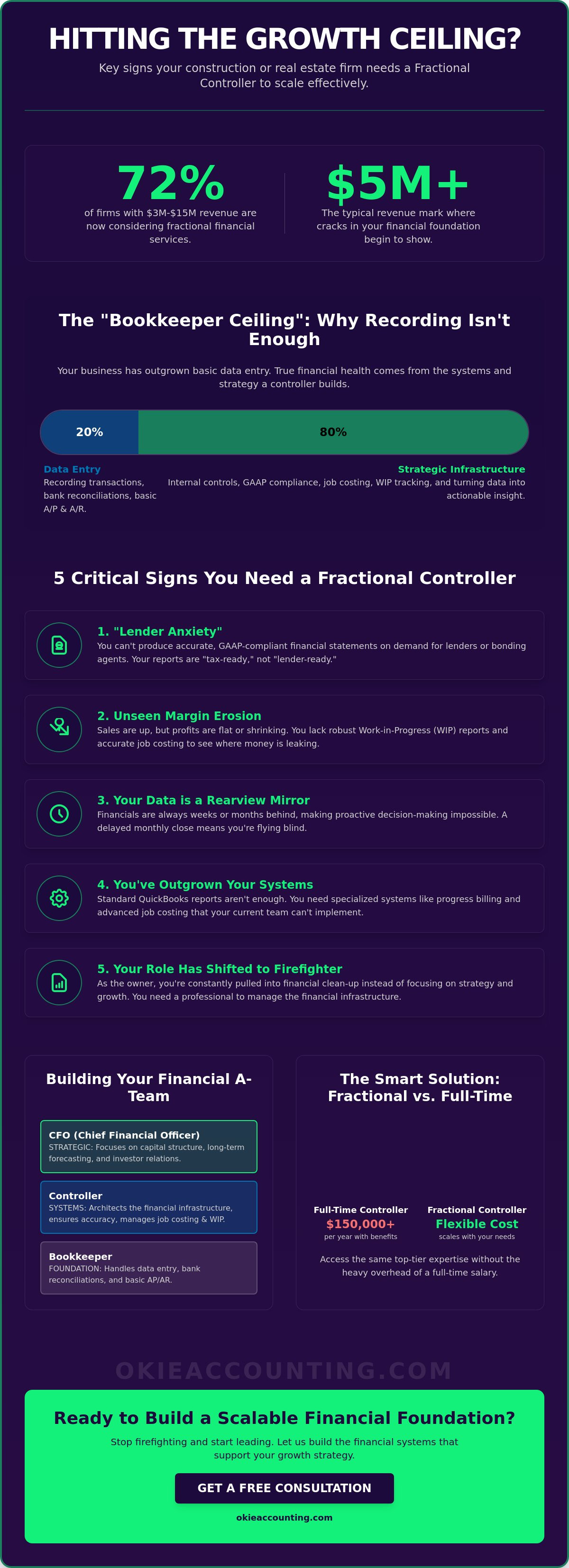
Many business owners in construction and real estate mistake bookkeeping for financial management. While a bookkeeper ensures that transactions are recorded and accounts are reconciled, they often hit a "bookkeeper ceiling" as the company grows. Recording transactions is only 20% of the financial health equation. The remaining 80% requires a professional who moves beyond reactive data entry to build a proactive, systems-first environment. A fractional controller serves as the primary architect of a firm’s financial infrastructure, designing the systems that turn raw data into strategic insight.
Understanding when to hire a fractional controller starts with recognizing that your business has outgrown its current reporting capabilities. This role provides high-level oversight on a part-time basis, allowing you to access the same expertise found in large corporations. This Fractional executive model is designed for firms that need professional discipline but aren't yet ready for a $119,497 annual salary commitment. By implementing internal controls and industry-specific workflows, a controller ensures that your financial data is both accurate and useful for decision-making.
The Hierarchy of Financial Oversight
Bookkeeping: This is your foundation. It focuses on the granular details of data entry, bank reconciliations, and basic accounts payable or receivable.
Controllership: This layer introduces internal controls, GAAP compliance, and accuracy. It's where job costing and work-in-progress (WIP) records are managed to ensure project profitability.
CFO: This strategic layer focuses on capital structure, long-term forecasting, and high-level investor relations.
Why "Fractional" is the Modern Solution for Growth
Hiring a full-time controller is a significant investment that often exceeds $150,000 when benefits and taxes are included. For a growing firm, this is often an unnecessary overhead burden. The fractional model allows you to scale your financial oversight as your project volume fluctuates. You get the benefit of national expertise delivered through cloud-based systems, ensuring your financial infrastructure is robust without the full-time price tag. It's a strategic partnership that provides real-time visibility into your margins. This approach helps you avoid the common mistake of hiring a CFO too early, which can drain resources without fixing the underlying reporting issues. Deciding when to hire a fractional controller is about choosing a disciplined system that scales without adding permanent overhead.
5 Critical Signs Your Business Needs a Fractional Controller
Knowing exactly when to hire a fractional controller is often the difference between sustainable growth and operational collapse. For many firms, the first sign isn't a lack of cash, but a lack of clarity. If you're seeing 72% of your peers in the $3 million to $15 million revenue range move toward fractional oversight, it's because they've hit the ceiling of what basic bookkeeping can handle. When your financial data feels like a look in the rearview mirror rather than a GPS, your infrastructure is failing you.
The Red Flag of "Lender-Ready" Financials
Lenders and bonding agents require more than just a standard QuickBooks printout. They need financials that adhere to GAAP standards, reflecting accurate accruals and liabilities. If a request for up-to-date statements triggers "Lender Anxiety," it's a sign your financial infrastructure is brittle. A controller ensures you transition from being "tax-ready" to "lender-ready" every single month. This level of discipline builds trust with external stakeholders and secures the bonding capacity needed for larger contracts. It's about moving from defensive accounting to offensive financial positioning.
Unseen Margin Erosion in Construction and Real Estate
Margin erosion is a silent killer in project-based industries. You might be winning bids and keeping crews busy, yet your bank account remains stagnant. A controller identifies where profit is leaking by implementing robust Work-in-Progress (WIP) reports. These reports are essential for accurate revenue recognition, ensuring you don't overbill or underbill on a contract. By tracking retainage and managing progress billing, a controller stabilizes your cash flow and protects your bottom line. If you can't see project-based profitability in real time, you're essentially bidding in the dark.
Consider these five indicators that your firm has reached a tipping point:
Sign 1: Lender Anxiety. You dread financial inquiries from banks because you don't trust the accuracy of your balance sheet.
Sign 2: The 15-Day Close Rule. Your monthly books aren't closed by the 15th of the following month, leaving you with stale data for decision-making.
Sign 3: Chronic Margin Erosion. Your gross profit margins are shrinking despite an increase in top-line revenue.
Sign 4: Lack of Job Costing. You lack a disciplined system to track labor, materials, and overhead against specific project budgets.
Sign 5: Regulatory Complexity. Managing new 2026 standards, such as the $2,000 threshold for 1099-NEC reporting, has become a significant administrative burden.
Identifying these signs early allows you to implement a fractional controller service before the cracks in your system become permanent. Real-time visibility isn't a luxury; it's a requirement for firms looking to scale responsibly. When you have a disciplined financial partner, you stop guessing and start growing with confidence.
Controller vs. CFO vs. Bookkeeper: Choosing Your Infrastructure
Building a scalable firm requires a clear understanding of the financial hierarchy. Many contractors struggle because they fall into the "missing middle" trap. They rely on a bookkeeper for years, then attempt to hire a high-level CFO when things get complicated, skipping the controller level entirely. This is an expensive mistake. A CFO focuses on the future and capital strategy, but they cannot be effective if the underlying data is a mess. Determining when to hire a fractional controller is about recognizing that you need a "Builder" to establish the systems before you need a "Visionary" to lead the strategy.
To choose the right infrastructure, consider this comparison framework for each role:
Bookkeeper: Focuses on the past. Their frequency is daily or weekly. Deliverables include bank reconciliations and basic transaction entry.
Controller: Focuses on the present. Their frequency is weekly or monthly. Deliverables include lender-ready financials, WIP reports, and internal controls.
CFO: Focuses on the future. Their frequency is often monthly or quarterly. Deliverables include capital structure planning, M&A analysis, and long-term equity strategy.
The Controller’s Operational Focus
The controller is the engine of your financial department. They manage the day-to-day accounting team and ensure data integrity across all projects. By establishing strict internal controls, they prevent the fraud and clerical errors that often plague growing construction firms. A controller doesn't just hand you a report; they interpret the "Why" behind the "What." If your labor costs spiked on a specific property, the controller identifies the trend before it causes significant margin erosion. They bridge the gap between raw data entry and high-level decision-making, ensuring every dollar is accounted for in your cloud-based system.
When Your Business Actually Needs a CFO
While a controller builds the infrastructure, a CFO is necessary for specific strategic triggers. You likely need a CFO if you are pursuing complex debt financing, navigating a merger, or restructuring equity for new partners. Companies using fractional CFOs report a 35% improvement in the quality of their financial decisions, but that improvement only happens if the controller has already cleaned the data. If you hire a strategic visionary while your job costing is still a guessing game, they will spend 80% of their time doing a controller's work at a much higher price point. Understanding when to hire a fractional controller ensures you have the disciplined foundation required for a CFO to eventually succeed. These roles collaborate best within a unified cloud environment, where the bookkeeper records, the controller verifies, and the owner leads with confidence.
Measuring ROI: How a Controller Pays for Themselves
A common misconception is that high-level financial oversight is a luxury reserved for enterprise-level firms. In reality, a fractional controller is an investment in margin protection, not a back-office expense. While the average annual salary for a full-time controller in May 2026 reached $119,497, the fractional model provides the same caliber of expertise at a 40% to 60% lower cost. This immediate savings is only the beginning of the value proposition. The true ROI comes from preventing the "Bad Data" trap. One miscalculated bid on a multi-unit development can easily cost your firm more than a year of professional service fees. Knowing when to hire a fractional controller allows you to catch these errors before they hit your balance sheet.
Beyond bid accuracy, you'll see significant savings during year-end reporting and seasonal transitions. While Okie Accounting Group LLC does not provide income tax preparation or certified audits, we provide the disciplined, lender-ready records that make your CPA’s job much faster. By delivering clean data, you reduce the billable hours your tax professional spends on basic cleanup and reconciliation. This efficiency ensures your financial infrastructure is prepared for the 2026 reporting changes, such as the new $2,000 threshold for Form 1099-NEC. A disciplined system protects your time and your capital.
Fixing the Cash Flow Crunch
Reducing Risk Through Internal Controls
Systemic discipline is the hallmark of a successful firm. A controller creates workflows that protect you from margin leak, clerical errors, and internal fraud. This oversight provides the real-time visibility needed for "Go/No-Go" decisions on new bids. You move from a "gut feel" leadership style to one driven by hard data. When you have confidence in your project-based profitability, you can bid more aggressively on high-margin work and walk away from projects that drain your resources. If you're ready to stop the profit leaks, explore how our Fractional Controller Services can stabilize your firm's growth.
Scaling Your Firm with Okie Accounting Group LLC
Scaling a construction or real estate firm requires a financial infrastructure that moves as fast as your project schedule. At Okie Accounting Group LLC, we don't just record what happened yesterday; we build the systems that protect your future. Our philosophy is rooted in a systems-first approach, ensuring that every transaction serves a strategic purpose. We understand that deciding when to hire a fractional controller is a pivotal moment for your business, often occurring when complexity begins to outpace your internal staff's capacity.
Industry-specific expertise is non-negotiable in this niche. Generalist bookkeepers often struggle with the nuances of progress billing or the complexities of retainage tracking. We specialize in the mechanics of your market, providing real-time visibility into your Work-in-Progress records and job costing. This level of detail ensures that your profit margins remain protected even as you take on larger, more demanding contracts. By partnering with Okie Accounting Group LLC, you gain a disciplined financial mentor who is as invested in your sustainable growth as you are.
Our Specialized Approach to Fractional Controllership
We leverage cloud-based integration to provide real-time visibility across the United States. This means you can access lender-ready financial statements from any job site, at any time. Our focus remains on accuracy and discipline, ensuring your data is always ready for a lender or bonding agent's review. We provide the professional infrastructure necessary to manage the 40% bonus depreciation rules and the increased $2.5 million Section 179 expensing limits effectively without adding permanent overhead.
Ready for Financial Clarity?
The transition from messy books to strategic oversight doesn't have to be overwhelming. It begins with a recognition that your current systems have reached their limit. We move you from a state of financial complexity to one of operational confidence. By implementing a structured remedy for margin erosion and inconsistent reporting, we help you build a firm that scales. You deserve a partner who understands the unique mechanics of your market and provides the clarity needed for informed decision-making.
If you're ready to stop the reactive firefighting and start leading with data-driven confidence, the next step is a comprehensive assessment of your financial health. We'll evaluate your current workflows, identify profit leaks, and design a roadmap for your future infrastructure. Get Started with Okie Accounting Group LLC today to secure the financial leadership your growing firm requires.
Establish the Financial Infrastructure Your Growth Demands
Transitioning from basic transaction recording to a systems-first accounting model is a requirement for firms exceeding the $5 million revenue threshold. You've learned that a disciplined controller protects your margins by preventing bid errors and optimizing project cash flow. By focusing on lender-ready accuracy and real-time visibility, you ensure your business remains attractive to bonding agents and banking partners. Identifying exactly when to hire a fractional controller marks the moment you stop managing by gut feel and start leading with data-driven precision.
Okie Accounting Group LLC provides the specialized oversight needed to navigate the complexities of construction and real estate finance. Our cloud-based national service delivers the expertise of lender-ready financial experts directly to your team. Don't let margin erosion or disorganized records stall your momentum. Take the next step toward operational clarity and Schedule a Strategic Financial Review with Okie Accounting Group LLC. It's time to build a financial foundation as robust as the projects you deliver.
Frequently Asked Questions
What is the difference between a bookkeeper and a fractional controller?
A bookkeeper focuses on recording historical data and reconciling bank accounts, while a fractional controller provides high-level oversight and data integrity. The bookkeeper manages the "what" of your transactions, but the controller manages the "how" and the "why." Controllers establish the internal controls and systems that prevent margin erosion and produce lender-ready statements.
How many hours a month does a fractional controller typically work?
Most fractional engagements range from 5 to 20 hours per month depending on your firm's complexity and project volume. This flexibility allows you to scale professional oversight without the 160-hour monthly commitment of a full-time employee. It's a strategic partnership designed to provide enterprise-level talent exactly when your infrastructure needs it most.
Is my business too small for fractional controller services?
Your business is ready for oversight when revenue exceeds $3 million or when financial complexity outpaces your current staff. Size isn't the only factor; the need for accurate job costing and WIP reports often dictates when to hire a fractional controller. If you manage multiple properties or high-value contracts, you aren't too small for disciplined systems.
Can a fractional controller help with my construction job costing?
Yes, implementing disciplined job costing is a core function of a fractional controller specializing in construction. They establish the workflows needed to track labor, materials, and equipment against specific project budgets in real time. This visibility ensures you identify profit leaks early and stop making bidding decisions based on a "gut feel."
Will a fractional controller replace my current bookkeeper?
No, a fractional controller typically supervises and mentors your existing bookkeeper rather than replacing them. They provide the high-level review and internal controls that a generalist bookkeeper may lack. This hierarchy creates a complete financial infrastructure where your bookkeeper handles data entry and the controller ensures the final reports are accurate.
How much does it cost to hire a fractional controller in 2026?
Hourly rates for fractional controllers in May 2026 range from $150 to $450 depending on industry expertise and experience. For highly strategic roles, rates can reach between $330 and $600 per hour. This model typically costs 40% to 60% less than the $119,497 average annual salary for a full-time controller.
What specific reports should a fractional controller provide every month?
You should receive Work-in-Progress (WIP) reports, cash flow forecasts, and lender-ready financial statements every month. These deliverables provide real-time visibility into project-based profitability and retainage tracking. A controller ensures these reports are finalized by the 15th of the following month to allow for informed, data-driven decision-making.
Do I need a fractional controller if I already have a CPA for taxes?
Yes, because a tax CPA focuses on compliance once a year, while a controller manages your financial health every day. Knowing when to hire a fractional controller is about realizing that tax preparation is not the same as operational oversight. A controller ensures your records are clean, which can significantly reduce your CPA's billable hours during tax season.



Comments