_edited_edited.jpg)

Controller vs CFO for Small Business: Which Strategic Leader Do You Need in 2026?

What if the executive salary you're hesitant to pay is the very investment required to stop your profit leaks? Many owners realize that while their books are "done," they still lack the clarity needed to make confident decisions about upcoming projects. When weighing the choice of a controller vs CFO for small business in 2026, the decision hinges on whether your current bottleneck is data accuracy or strategic direction. You've likely felt the stress of receiving late reports or facing uncertainty about your cash flow; you're right to be cautious about over-hiring before your foundation is secure.
This article provides a structured framework to help you distinguish between the operational oversight of a controller and the forward-looking strategy of a CFO. You'll discover how to identify which role will drive your business toward scalable growth while ensuring your financial systems remain resilient. We will break down the specific milestones, such as the tightened $1 million revenue threshold for small business lending rules, that signal it's time to move beyond basic administration toward rigorous management and profit protection.
Key Takeaways
Distinguish between the Controller’s focus on historical data integrity and the CFO’s role in architecting long-term capital strategy.
Navigate the controller vs cfo for small business debate by identifying the specific revenue triggers and operational complexities that demand specialized oversight.
Understand how a Controller builds the foundational systems and internal controls that enable accurate, long-term financial forecasting.
Compare how each leader approaches profit protection, moving from basic administrative tasks to the construction of comprehensive structural frameworks.
Discover how fractional leadership models allow you to access specialized expertise and cash flow forecasting without the cost of a full-time executive salary.
Understanding the Roles: Financial Controller vs. CFO Explained
Many small business owners treat executive job titles as interchangeable labels. They often assume that any senior financial professional can handle every aspect of their company's money. This misunderstanding creates significant risk. Choosing between a controller vs cfo for small business needs requires a clear grasp of where their responsibilities begin and end. While both roles are dedicated to your company's health, they operate on entirely different planes of the business lifecycle.
The fundamental difference is one of perspective. A controller looks backward and inward. They focus on the precision of historical data and the integrity of internal systems. A CFO looks forward and outward. They focus on capital strategy and the long-term vision of the organization. One builds the foundation; the other architects the growth. Confusing these roles often leads to paying executive rates for operational tasks or, conversely, expecting strategic miracles from a professional who is focused on compliance.
The Financial Controller: Your Chief of Accuracy
The Financial Controller acts as the primary guardian of your company's data integrity. Their work centers on the construction of comprehensive structural frameworks that ensure every transaction is recorded correctly. They manage the general ledger, oversee GAAP compliance, and ensure that the month-end close is both timely and accurate. This role provides the financial readiness your business needs to survive an external review or a sudden lender inquiry.
Beyond simple oversight, a controller establishes the internal controls that prevent fraud and minimize errors. They are the bridge between raw bookkeeping and the sophisticated financial reporting required for daily management. If your reports are late or inconsistent, you likely have a controller-level problem. Their discipline ensures that the data you use to make decisions is bulletproof and organized. They don't just count the money; they ensure the counting is beyond reproach.
The CFO: Your Strategic Growth Partner
A CFO serves as the high-level advisor to the CEO. Their focus shifts away from the granular details of the ledger toward capital structure and high-level strategy. They drive the business model by analyzing competitive markets, managing equity, and overseeing fundraising efforts. If your company is preparing for a merger or a significant acquisition, the CFO leads the charge.
They don't just report on what happened last month. Instead, they use that data to model what will happen in the future. Their value lies in interpreting financial trends to mitigate risk and identify new revenue streams. By maintaining a forward-looking stance, the CFO ensures that your business remains resilient in a changing market. They transform the controller's accurate data into a roadmap for long-term stability and profit protection. You're not just hiring for a role; you're hiring for a strategic partnership that shapes your future capital.
Operational Integrity vs. Strategic Vision: Where the Roles Diverge
The choice between a controller vs cfo for small business is essentially a choice between tactical execution and strategic vision. A controller serves as the master of the present. They build the structural frameworks required to capture every dollar spent on a job site or in the office. Without this tactical accuracy, a CFO's strategic vision is built on sand. Many owners make the mistake of hiring a high-level strategist before their basic data is reliable. If your financial reports aren't accurate today, a five-year forecast won't protect your profit tomorrow.
Think of the relationship as a relay race. The controller runs the first leg by ensuring all operational data is clean, compliant, and categorized. They hand off a finished set of books to the CFO, who then uses that data to project future performance. If the controller trips on the first leg, the CFO cannot win the race. Strategic decisions like capital allocation or equity management require the absolute certainty that only a disciplined controller can provide. Hiring a CFO before your accounting systems are structurally sound is a recipe for expensive, data-driven mistakes.
The Controller’s Domain: Systems and Controls
In high-complexity sectors like construction or real estate, the controller’s role is indispensable. They focus on the granular details of project-based tracking. This includes mastering QuickBooks for contractors to ensure that job costing is precise and up to date. A controller manages Work-in-Progress (WIP) reports, ensuring that revenue recognition aligns with actual project completion. Their daily oversight extends to managing the accounting staff and maintaining strict payroll management compliance. They ensure that your internal controls are strong enough to prevent the financial leaks that often plague growing firms.
The CFO’s Domain: Capital and Risk
Knowing When to Hire a CFO is often a matter of shifting your focus from internal management to external negotiation. A CFO spends their time managing relationships with lenders and investors rather than managing the ledger. They negotiate credit lines and navigate the complexities of new 2026 lending regulations that affect small business data collection. Their value is found in developing complex financial models for 3-5 year growth trajectories. They analyze market trends to help you pivot your business model during economic shifts, ensuring long-term stability. If you're unsure where your current gaps lie, it may be helpful to schedule a brief discovery call to assess your structural readiness.
Comparing the Impact: Reporting, Compliance, and Capital Strategy
The impact of a financial leader is most visible in how they treat your Profit & Loss (P&L) statement. To a controller, the P&L is a document that must be reconciled to the penny. Accuracy is their primary currency. They verify that every entry is backed by documentation and correctly categorized according to GAAP standards. By contrast, a CFO views the same statement as a diagnostic tool. They look past the numbers to determine if the current business model remains viable in a shifting market. While a controller ensures the tank is full and the engine is running, a CFO decides where the ship should sail.
This difference extends to how each role manages your cash flow. A controller focuses on the daily and weekly cycle. They manage accounts receivable and payable to ensure you have the liquidity to meet immediate obligations. A CFO’s focus is on securing the cash required for future expansion. They look at the "cost of capital" and determine whether your growth should be funded through debt, equity, or retained earnings. This distinction is vital for those debating the controller vs cfo for small business hierarchy; you cannot strategically deploy capital if you don't first have a controller managing the cycle that generates it.
Financial Reporting: Accuracy vs. Interpretation
Accuracy is the foundation, but interpretation drives growth. A controller’s reporting ensures that your data is bulletproof for lenders or potential buyers. For example, if a specific project runs over budget, a controller will flag the variance and identify exactly where the overage occurred. They provide the "what" and the "where."
The CFO takes that data to provide the "why" and the "what next." They might analyze that over-budget project to see if it represents a trend in your industry. They decide if that specific project type should be discontinued or if your pricing model needs a complete overhaul. Our Controller services focus on providing these interpretive insights, moving you beyond basic data entry toward a state of financial readiness.
Risk Management: Internal vs. External
Risk management requires a two-pronged approach. Controllers mitigate risk through internal controls. They establish a segregation of duties to prevent fraud and ensure that no single employee has unchecked access to company assets. This internal focus is the first line of defense against profit leakage. CFOs focus on external risks. They mitigate threats through insurance, hedging, and diversification strategies. They protect the business from market volatility and economic shifts. For a small business, the controller’s internal focus is usually the priority. You must secure your house before you can effectively guard the perimeter.
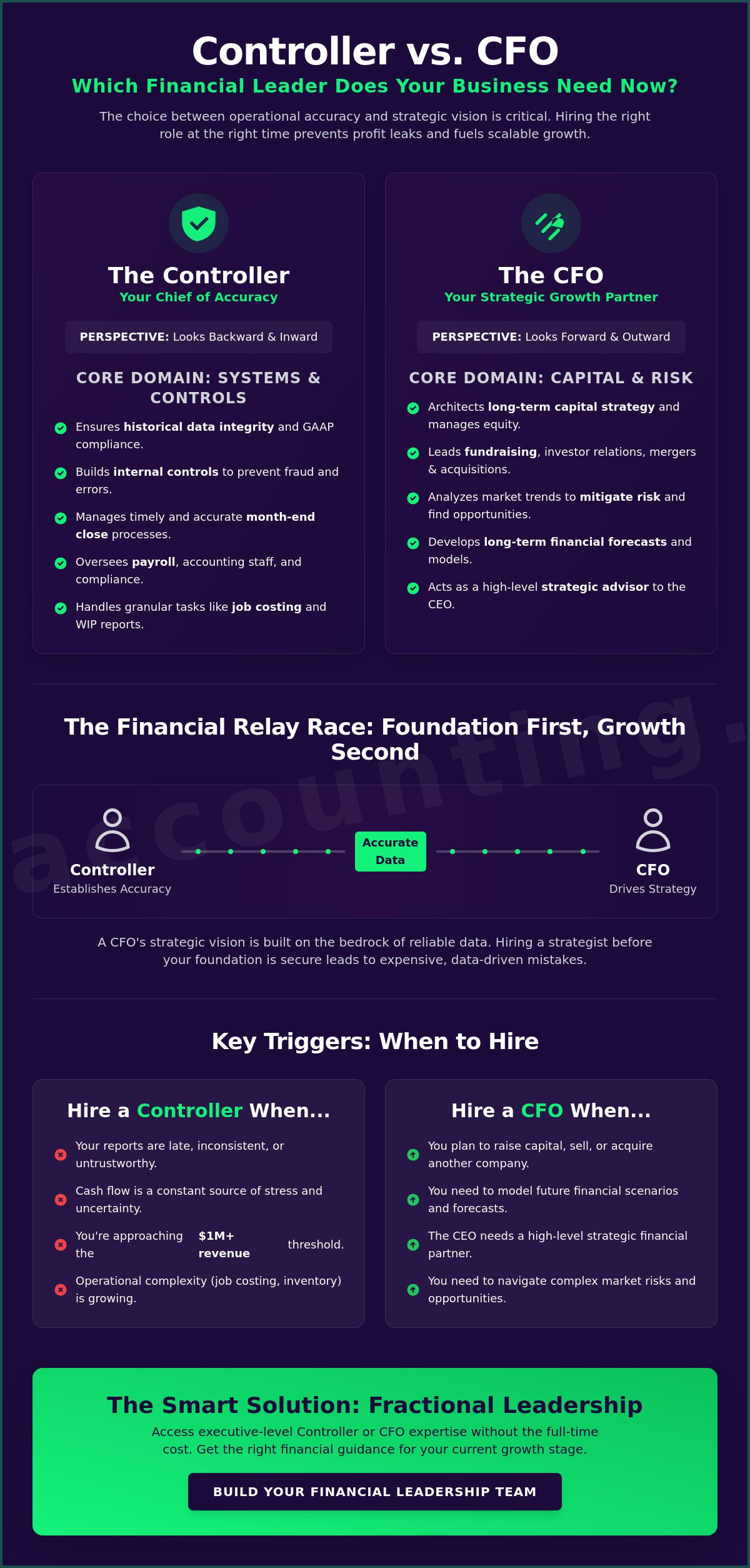
Decision Matrix: When to Hire a Controller vs. a CFO
The decision to hire isn't just about revenue; it's about the complexity of your financial ecosystem. For most firms, the $1 million to $10 million revenue range represents the "Controller Sweet Spot." At this stage, your primary need is the construction of structural frameworks that can handle increasing transaction volumes and multi-entity reporting. If you're still asking "How are we doing?" and struggling to get a straight answer, you're facing a controller-level gap. The conversation regarding controller vs cfo for small business shifts toward the CFO only when the question becomes "How do we scale or exit?"
Organizational complexity often serves as a more reliable trigger than revenue alone. If your business operates across multiple legal entities, manages a high volume of daily transactions, or handles complex payroll across several states, the administrative burden will eventually break a standard bookkeeping setup. You need a leader who can manage the accounting staff while ensuring that your internal controls remain bulletproof. This level of oversight provides the financial readiness required to satisfy lenders and protect your profit margins as you grow.
Signs You Need a Controller Now
The most common signal is a month-end close that drags past the 15th day of the following month. This delay indicates that your current processes can't keep pace with your operational growth. Firms struggling with construction bookkeeping services or intricate project-based tracking often reach a breaking point where a bookkeeper's administrative focus is no longer enough. You need the oversight of a professional who can ensure your financial statements are bank-ready and accurate. If you feel you've reached this limit, it may be time to consult a fractional controller to stabilize your foundation.
Signs You Are Ready for a CFO
A CFO becomes necessary when your financial needs move beyond internal reporting and into external capital strategy. This trigger usually occurs during a major pivot, such as preparing for an acquisition or a significant capital raise. You need a strategic partner who can build high-level financial models to project your trajectory over the next three to five years. If you are actively managing an exit strategy or navigating complex equity management, the visionary focus of a CFO is required to protect your long-term interests. To determine which level of support aligns with your current growth stage, you can book a discovery call with our team today to discuss your specific needs.
Scaling Smarter: The Case for Fractional Financial Leadership
Hiring a full-time executive often represents a significant financial leap that many growing firms aren't ready to take. While the gap between a bookkeeper and a strategist is wide, the fractional model bridges this divide by offering senior-level expertise on a flexible schedule. This strategy addresses the controller vs cfo for small business debate by allowing you to pay for specific outcomes rather than a full-time seat. It ensures your business has the structural frameworks required for growth without the immediate burden of a six-figure executive salary.
Fractional leadership is designed to be agile. As your project volume fluctuates or your revenue milestones shift, the level of oversight can be adjusted to match your needs. You aren't just outsourcing tasks; you're gaining a strategic mentor who ensures your financial systems are resilient. This model provides the discipline of a corporate finance department while allowing you to remain nimble in a competitive market. It allows you to transition from a state of reactive accounting to proactive financial management.
The ROI of Fractional Oversight
The primary advantage of this model is the immediate impact on your bottom line. When you evaluate fractional controller pricing, you'll see it's an investment in profit protection. You gain access to high-level expertise that prevents costly errors in job costing and payroll. By delegating these technical responsibilities, you can focus your time on revenue-generating activities, knowing that your general ledger is being managed with professional precision. This specialized oversight often identifies profit leaks that generalist providers miss, such as unbilled expenses or inaccurate labor allocations.
Transitioning from Service Provider to Strategic Partner
Okie Accounting Group LLC doesn't just manage your accounts; we integrate with your team to drive long-term health. We provide the management accounting necessary to turn raw data into a roadmap for success. Our team brings specialized knowledge in construction and real estate, ensuring that your project-based tracking is handled with industry-specific rigor. We focus on the construction of foundational systems that grow with you, moving beyond basic administrative tasks. This transition from a service provider to a strategic partner is the core of our identity. To see how this model fits your current stage, schedule a consultation for fractional controller services today.
Secure Your Scalable Financial Foundation
Establishing a resilient business requires moving beyond basic administration toward a state of total financial readiness. You've seen how the choice between a controller vs cfo for small business depends on your current stage of growth and the specific complexities of your project load. While the controller provides the structural integrity of your data, the CFO uses that foundation to architect your future capital strategy. Utilizing a fractional model allows you to access this specialized leadership without the overhead of a full-time executive salary.
Okie Accounting Group LLC serves as a strategic mentor, offering the specialized expertise required to navigate the mechanics of construction and real estate. Our cloud-based accounting systems provide nationwide support, ensuring your financial health is maintained regardless of your location. We remain focused on profit protection and the construction of frameworks that allow you to scale with confidence. It's time to stop guessing about your margins and start leading with data-driven clarity.
Gain financial clarity with our Fractional Controller services. Your path to long-term stability begins with a single conversation. We're ready to help you transform your financial data into a roadmap for sustainable success.
Frequently Asked Questions
Can one person be both a Controller and a CFO in a small business?
Yes, in smaller firms, one individual often manages both roles, though their focus usually leans toward one side. A controller might handle strategic forecasting, or a CFO might dive into month-end close. However, as complexity increases, the distinction becomes vital to prevent burnout. It ensures both historical accuracy and future strategy are addressed with equal rigor by the appropriate specialist.
What is the typical salary difference between a Controller and a CFO?
Full-time CFO salaries in 2026 typically range from $150,000 to $300,000 for companies under $50 million in revenue. In contrast, corporate controller salaries generally fall between $150,000 and $210,000. This gap reflects the CFO's broader responsibility for external capital strategy and high-level risk management compared to the controller's focus on internal systems and data integrity.
Does a small business need a Controller if they already have a great bookkeeper?
Yes, because a bookkeeper records data while a controller manages the systems that ensure that data is accurate and compliant. If you find that your financial reports are late or you lack confidence in your job costing, a bookkeeper alone is likely insufficient. A controller provides the structural framework and oversight necessary to bridge the gap between simple data entry and strategic financial reporting.
How many hours a month does a fractional controller usually work?
The time commitment for fractional services varies based on your firm’s complexity and transaction volume. Most small businesses find that 10 to 40 hours per month provides the necessary level of oversight for month-end close and cash flow forecasting. This flexibility allows you to scale the service as your project load increases or during intense periods of financial readiness.
Will a fractional controller help with my QuickBooks setup?
Yes, fractional services include specialized QuickBooks setup and training to ensure your ledger is built for structural integrity from day one. This is especially critical for firms in construction or real estate that require complex project-based tracking. Proper setup prevents future data leaks and ensures that your financial reporting is automated and reliable.
What is the main difference between a Controller and a Comptroller?
The main difference lies in the sector; "comptroller" is typically used in government or non-profit organizations, while "controller" is the standard term in the private sector. Both roles serve as the chief accounting officer responsible for financial reporting and internal controls. In the context of a controller vs cfo for small business discussion, they both represent the guardian of historical data accuracy.
Can a Controller help my business get a loan or line of credit?
A controller helps you secure a loan by ensuring your financial statements are accurate, compliant, and ready for lender scrutiny. While a CFO might lead the negotiation, the controller provides the verified data and reporting that banks require. Their work ensures that your business meets the new 2026 lending data requirements under revised Regulation B and demonstrates financial stability to external partners.
Should I hire a CFO if I am planning to sell my business in two years?
Yes, hiring a CFO two years before a sale is a strategic move to maximize your company's valuation. They focus on optimizing your capital structure, cleaning up equity management, and building the financial models that buyers analyze during due diligence. This forward-looking approach ensures you exit the business with the highest possible return on your investment while maintaining operational clarity during the transition.



Comments