
The Ultimate Construction Bookkeeping Checklist for 2026: Systems for Scalability
- Wendy Okie

- May 12
- 12 min read
Updated: May 18
With construction inflation projected between 4% and 5% in 2026, a single unrecorded change order or a missed progress billing cycle can erase your entire net profit before you even break ground on the next phase. You didn't start your company to spend your weekends reconciling job costs or worrying if your financial statements are lender-ready for a bonding increase. It's frustrating when you're managing a portion of the $2.185 trillion annual construction spend but still feel like you're losing the battle against margin erosion and cash flow gaps.
This 2026 construction bookkeeping checklist is designed to move you from reactive recording to proactive oversight. You'll learn how to build a disciplined financial infrastructure that navigates complex retainage policies and ever-changing tax codes with ease. We're laying out the exact monthly systems that provide real-time visibility into project profitability; this ensures your business remains scalable and independent of your constant manual intervention. We will cover everything from WIP reporting to the specific payroll benchmarks needed to navigate the $184,500 Social Security wage base limit for the coming year.
Key Takeaways
Learn how to standardize your Chart of Accounts to move beyond generic software setups and capture the construction-specific data required for lender-ready reporting.
Master the mechanics of Work-in-Progress (WIP) reporting to ensure your financial statements accurately reflect project profitability and prevent margin erosion.
Implement this comprehensive construction bookkeeping checklist to transition from manual transaction entry to a disciplined, systems-first financial infrastructure.
Streamline subcontractor compliance by establishing rigorous workflows for tracking insurance certificates, W-9s, and lien waivers before payments are issued.
Discover how fractional controller services provide the strategic financial oversight necessary to scale your business without relying on the owner for daily back-office tasks.
Table of Contents
Establishing Your Financial Infrastructure: The Setup Checklist
Most specialty contractors fail to scale because they treat their accounting software as a digital shoebox rather than a strategic tool. A generic setup might track what you spent, but it won't tell you why you lost 3% on a specific framing phase or why your cash flow stalled despite a record-breaking backlog. Building a disciplined financial infrastructure is the first step in any effective construction bookkeeping checklist. It transforms your back office from a cost center into a source of real-time visibility. Without this foundation, you're simply recording history instead of steering your company's future.
The Construction-Specific Chart of Accounts
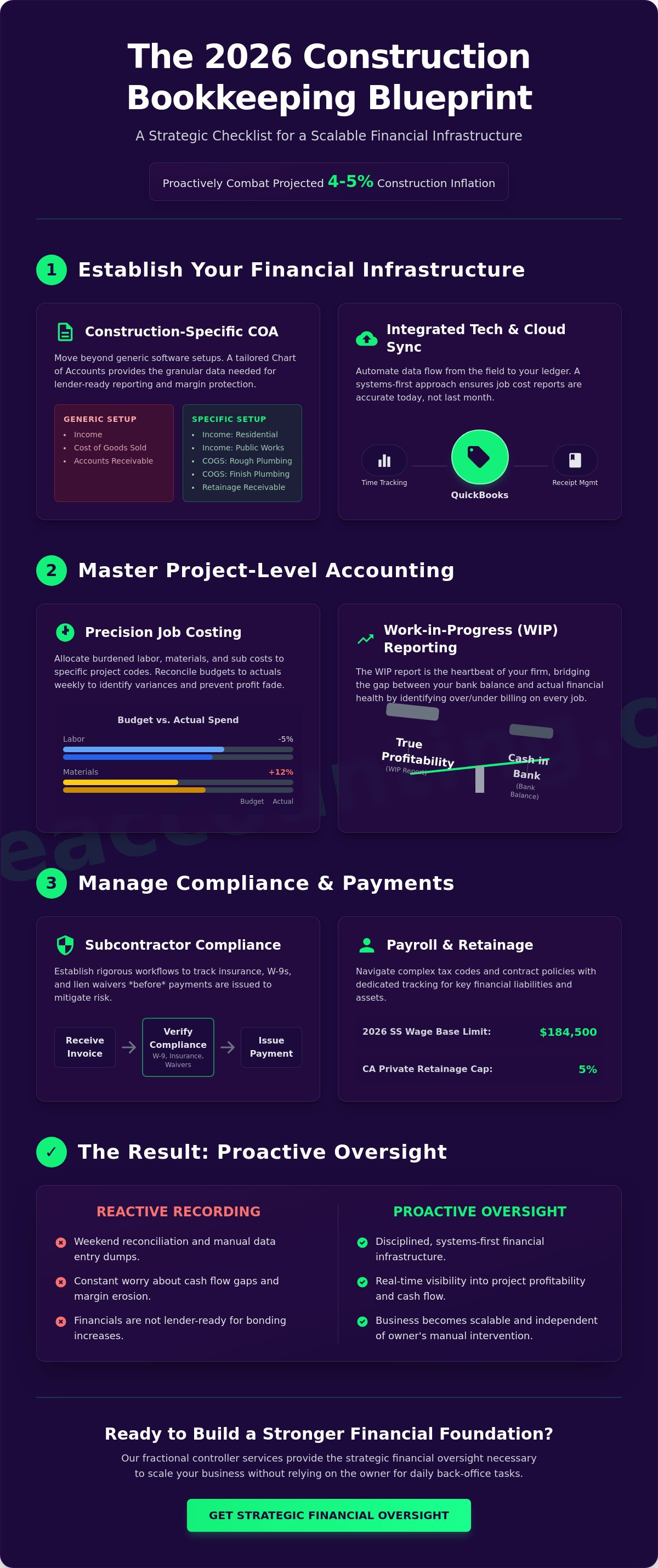
A standard Chart of Accounts (COA) is insufficient for the complexities of construction accounting principles. To prevent margin erosion, you must segment your income by service line or project type, such as residential versus public infrastructure. Your Cost of Goods Sold (COGS) must mirror your project estimates precisely. If your estimate tracks "Rough Plumbing" and "Finish Plumbing" separately, your COA should too. This alignment allows for "apples-to-apples" reporting that highlights exactly where slippage occurs. Additionally, you must establish "Other Income" categories for non-operational items, ensuring they don't distort your true operational gross margins. With California's 5% retainage cap on private contracts effective January 1, 2026, your COA must also include dedicated accounts to track these withheld funds across multiple years without losing them in the general receivables pool.
Software and Cloud Integration
A professional QuickBooks setup for contractors serves as the heartbeat of your system, but it shouldn't exist in a vacuum. You need a "systems-first" approach that integrates field data directly into your ledger. This means selecting third-party apps for receipt management and time-tracking that sync in real-time. When a foreman uploads a material receipt from the job site, it should automatically map to the correct project and cost code. This automation eliminates the "Friday afternoon data dump" and ensures your job cost reports are accurate as of today, not last month. Standard Operating Procedures (SOPs) for data entry are the final piece of this infrastructure. You must define exactly who enters field reports, how receipts are coded, and when the sync between project management and accounting is verified. This level of discipline ensures that your construction bookkeeping checklist produces lender-ready financial statements that reflect the true health of your business.
Mastering Project-Level Accounting: Job Costing and WIP
Work-in-Progress (WIP) accounting is the heartbeat of a successful construction firm because it bridges the gap between your bank balance and your actual financial health. While your bank account shows cash, the WIP report shows the truth. It identifies whether you're over-billed or under-billed on every contract in your portfolio. With the U.S. construction industry projected to grow by 1.6% in 2026, maintaining this level of granular oversight is what separates firms that scale from those that eventually collapse under their own growth. A robust construction bookkeeping checklist must prioritize job costing to prevent profit fade, which is the slow erosion of margins as a project progresses toward completion.
Effective job costing requires tracking labor, materials, and subcontractors with surgical precision. You shouldn't just record total payroll; you must allocate burdened labor costs, including taxes and benefits, to specific project codes. If you aren't reconciling project budgets to actual spend weekly, you're essentially flying blind. This discipline allows you to identify variances early. For instance, if your material costs for a data center project are 12% higher than the estimate in the first month, you can adjust your procurement strategy before the gap becomes unmanageable. If your current reporting feels disconnected from the reality on the job site, our financial reporting services can provide the clarity you need to stay profitable.
The WIP Schedule Reconciliation
To maintain lender-ready financial statements, you must reconcile your WIP schedule to your balance sheet monthly. This involves recording "Costs in Excess of Billings" as an asset, representing work you've performed but haven't yet invoiced. Conversely, "Billings in Excess of Costs" must be recorded as a liability, as this represents cash received for work you still owe the client. Proper WIP reconciliation prevents misleading profit spikes by aligning revenue recognition with the physical completion of the project. This ensures your net income remains steady and predictable, which is exactly what bonding companies look for when evaluating your capacity.
Job Cost Categories and Coding
Consistency is the foundation of a scalable financial infrastructure. You must standardize cost codes across all projects, ideally using the CSI MasterFormat or a similar industry standard. This allows you to compare performance across different jobs and identify which types of work are your most profitable. Tracking material deliveries and equipment rental usage by project ensures that no indirect cost goes unallocated. When you reconcile project budgets to actual spend weekly, you create a feedback loop that informs future estimates. This systematic approach ensures that your overhead is properly absorbed by your active projects, protecting your bottom line from the "death by a thousand cuts" caused by unallocated expenses.
Managing Compliance: Payroll, Subcontractors, and Retainage
Compliance in the construction industry is a moving target that requires more than a year-end review. While generalist firms treat 1099-NEC preparation as a January 31 task, a disciplined construction bookkeeping checklist integrates compliance into the monthly workflow to prevent legal exposure and cash flow bottlenecks. Managing these moving parts ensures your business remains lender-ready and protected from the liabilities inherent in large-scale projects. If your current system doesn't account for the daily nuances of lien waivers or state-specific retainage caps, you're leaving your profit margins vulnerable to unnecessary risk.
Retainage Tracking Systems
Retainage isn't just a deferred payment; it's a specific financial obligation that requires dedicated oversight. For private contracts in California entered into after January 1, 2026, retainage is capped at 5% of each progress payment. Your accounting system must reflect this by utilizing separate balance sheet accounts for retainage receivable and retainage payable. This separation ensures that these funds are excluded from your standard AR aging reports, preventing you from chasing "overdue" balances that aren't yet legally due. A systems-first approach includes a formal follow-up process to trigger retainage release within 45 days of project completion, as required by law, ensuring your cash flow remains fluid.
Subcontractor and Labor Compliance
Protecting your firm from subcontractor-related risks requires a proactive stance on documentation. You should never process a payment without first verifying that a subcontractor’s Certificate of Insurance (COI) and W-9 are current. Automating the collection of lien waivers with every invoice is a non-negotiable step in maintaining a clean financial infrastructure. This process prevents double-payment risks and ensures that your project owners remain confident in your management. For projects involving public funds, your team must also master the complexities of Davis-Bacon and certified payroll requirements, which demand precise reporting of hourly rates and fringe benefits.
Managing construction payroll services in 2026 also means staying ahead of evolving tax thresholds. With the Social Security wage base limit rising to $184,500 this year, your payroll systems must be configured to automatically adjust withholding once an employee hits that cap. Failure to track these limits or the additional 0.9% Medicare tax on wages exceeding $200,000 can result in significant penalties and audit anxiety. By standardizing these compliance tasks within your monthly routine, you shift from a state of reactive stress to one of operational clarity and confidence.
The Construction Bookkeeping Workflow: Daily, Weekly, and Monthly Tasks
A generic construction bookkeeping checklist often fails because it treats financial management as a once-a-year event for tax preparation. Real scalability requires a disciplined cadence of daily, weekly, and monthly habits that prevent data backlogs and margin erosion. This structured workflow ensures that your financial data is always current; it allows you to make informed decisions based on reality rather than intuition. By establishing these routines, you shift from being a reactive business owner to a proactive strategist who controls the company's financial destiny.
Daily tasks are the foundation of your financial infrastructure. Every day, your field team must record material deliveries and submit receipts through your cloud-based management tool. This isn't just administrative busy work. With construction inflation projected between 4% and 5% in 2026, verifying material costs against your original estimates immediately is vital. If a supplier raises prices unexpectedly, you need to know today, not three weeks later when the invoice arrives. Quarterly and annual tasks, such as managing the 1099-NEC filing deadline of January 31, 2026, become routine when your daily data is clean and your fixed asset depreciation is tracked in real-time.
The Weekly Financial Pulse Check
Your weekly routine should focus on liquidity and labor efficiency. Reviewing your Accounts Receivable (AR) aging report ensures you're following up on progress billings before they become a cash flow liability. You must check your cash flow forecasts against upcoming vendor payments to avoid gaps that could damage your reputation with suppliers. Crucially, you need to analyze labor hours against project estimates. If a crew is burning through 20% more hours than budgeted on a specific phase, you can address the inefficiency before it consumes your entire net margin. This weekly discipline prevents small variances from snowballing into project-wide losses.
The Monthly Close Process
The monthly close is the bridge between recording transactions and strategic oversight. This process involves reconciling all bank and credit card accounts to ensure every dollar is accounted for. You must review your Profit & Loss statement by job to confirm that your actual costs align with your project-level accounting. This is also the time to perform the WIP adjustments we discussed earlier; this aligns your revenue with the physical completion of the work. If you're ready to transition from manual data entry to a strategic partnership, our monthly bookkeeping services provide the disciplined oversight your firm needs to scale.
By generating lender-ready financials for your bonding agents every month, you demonstrate a level of professional discipline that builds trust. This consistent workflow removes the anxiety of audits and ensures you're always prepared for the next growth opportunity. It transforms your construction bookkeeping checklist from a list of chores into a powerful engine for sustainable growth.
Beyond the Checklist: Scaling with Strategic Financial Oversight
Completing a construction bookkeeping checklist provides a necessary foundation, but scaling a firm requires a shift from recording history to predicting performance. Many construction owners reach a plateau where their revenue is climbing, yet their bank balance remains stagnant. This often happens because a generalist bookkeeper, while capable of categorizing expenses, lacks the specialized expertise to manage the complex financial infrastructure of a high-growth contractor. When your financial reports are consistently delayed or fail to reflect the real-time reality of your job sites, your back office has become a bottleneck for your growth rather than an engine for it.
Strategic financial oversight allows you to use your historical data to make more informed bidding decisions. While we previously discussed the importance of daily and weekly workflows, the true value of these systems is the ability to forecast future performance. By analyzing your job cost data over several quarters, you can identify which project types yield the highest net margins and which ones are prone to slippage. This data-driven approach ensures you aren't just winning more work; it ensures you're winning the right work at the right price to support sustainable expansion.
Signs You Have Outgrown Basic Bookkeeping
The transition to a more sophisticated system usually becomes necessary when you experience consistent cash flow surprises despite high revenue. If you find yourself unable to secure bonding or bank financing because your reports lack the detail required by underwriters, your current system is failing you. Margin erosion is the silent killer of construction firms, acting as the slow, untracked leakage of profit through unallocated overhead and missed change orders. When you can no longer explain exactly where your profit went at the end of a project, you've officially outgrown basic bookkeeping and need a systems-first approach to financial management.
The Value of a Strategic Partner
A fractional controller acts as a disciplined mentor for your business, establishing the internal controls necessary to prevent fraud and costly data entry errors. This level of oversight ensures you have lender-ready financials for contractors that can be produced at a moment's notice. Instead of just checking boxes on a construction bookkeeping checklist, a strategic partner helps you interpret the data to forecast future cash needs and manage the evolving tax and payroll limits effectively. This move from a service provider to a strategic partnership provides the quiet confidence you need to lead your company toward long-term stability.
Ready to move beyond the checklist and build a scalable financial infrastructure? Schedule a strategy session with Okie Accounting Group LLC.
Build Your Financial Foundation for Sustainable Growth
Transitioning from a reactive back office to a disciplined financial infrastructure is the only way to protect your margins as the industry moves toward $2.185 trillion in annual spending. By implementing this construction bookkeeping checklist, you've taken the first step toward reclaiming control over your project profitability. You now understand that real-time visibility into your WIP reports and a standardized Chart of Accounts are not just administrative tasks; they are the strategic tools required to prevent the silent killer of margin erosion. Maintaining this level of oversight ensures you can handle the 4% to 5% inflation projected for 2026 without sacrificing your bottom line.
Scaling your firm shouldn't mean increasing your personal workload or sacrificing your weekends to reconcile receipts. We specialize in the complex mechanics of Job Costing and WIP accounting, ensuring your financial statements remain lender-ready for bonding requirements and banking relationships. With our nationwide fractional controller support, you can shift your focus from daily data entry to high-level bidding and project execution. Gain financial clarity with specialized construction bookkeeping services. We are here to partner with you as you build a more resilient and profitable future.
Frequently Asked Questions
What is the difference between general bookkeeping and construction bookkeeping?
Construction bookkeeping prioritizes project-level data over simple period-based tracking by utilizing specialized mechanics like job costing, progress billing, and retainage tracking. While general bookkeeping records what you spent, construction accounting explains why costs deviated from the original estimate. This level of detail is necessary to prevent margin erosion on multi-year projects where revenue recognition depends on the physical completion of work.
How often should I reconcile my WIP schedule?
You should reconcile your WIP schedule every single month as part of your standard construction bookkeeping checklist. This monthly reconciliation ensures that your revenue recognition aligns with the actual physical progress of each job. It prevents the misleading profit spikes that occur when billings and costs aren't properly synchronized; this keeps your financial statements accurate for bonding agents and lenders.
Why is job costing so important for specialty contractors?
Job costing provides real-time visibility into the profitability of specific tasks, allowing you to identify variances before they consume your entire net margin. For specialty contractors, this means knowing if a specific crew is hitting their estimated benchmarks for labor and materials. Accurate job costing data allows you to bid more competitively on large-scale infrastructure projects while protecting your company's long-term financial health.
What are the most common bookkeeping mistakes construction companies make?
The most frequent errors include failing to track retainage in separate balance sheet accounts and neglecting to reconcile field labor hours with accounting cost codes. Many firms also forget to make WIP adjustments at month-end, which leads to skewed profit reports. These mistakes result in "silent" margin erosion and financial statements that aren't lender-ready when you need to increase your bonding capacity.
Do I need a specific software for construction accounting?
You don't necessarily need a proprietary ERP, but you do need a professional QuickBooks setup for contractors that integrates with your field data. The software must be configured to handle cost codes, project-level reporting, and automated receipt management. A generic setup will fail to provide the granular data needed for a systems-first approach to financial infrastructure and scalable growth.
How does retainage affect my cash flow and financial statements?
Retainage creates a significant cash flow gap by withholding a portion of your earned revenue until project completion. Under California law effective January 1, 2026, this is capped at 5% for private contracts. Your financial statements must track this as a separate asset; this ensures your AR aging remains accurate and prevents you from treating withheld funds as overdue debt.
What documents should I collect from subcontractors before paying them?
Before issuing any payment, you must collect a W-9 form, a current Certificate of Insurance (COI), and a signed lien waiver for the current billing period. This discipline protects your firm from double-payment risks and ensures compliance with insurance requirements. It's a non-negotiable step in your construction bookkeeping checklist for maintaining a clean and protected financial infrastructure.
When should I hire a fractional controller instead of a full-time bookkeeper?
You should hire a fractional controller when your revenue is growing but your cash flow remains unpredictable or difficult to forecast. If you're struggling to produce lender-ready financials or need to manage the $184,500 Social Security wage base limit across a large crew, a controller provides the necessary strategic oversight. They build the systems that ensure long-term stability rather than just recording historical transactions.


Comments